
C.S. Lewis’s The Chronicles of Narnia has captured the imagination of readers for generations, inspiring numerous adaptations across television, film, radio, and stage. From early British television broadcasts to big-budget Hollywood blockbusters and upcoming streaming events, the journey into Narnia has taken many forms over the decades.
Here is a comprehensive look at every major film and television adaptation of the Narnia universe, detailing key talent, historical significance, and notable changes from the source material.
1. The Lion, the Witch and the Wardrobe (1967 TV Serial)
- Format: Live-Action Television Miniseries (ABC Television / BBC-adjacent production)
- Key Talent: Directed by Helen Standage; written by Trevor Prest.
- Significance: This marks the very first screen adaptation of C.S. Lewis’s beloved masterwork, predating the more widely known animated and live-action versions by decades.
- Notable Changes: Due to extremely limited 1960s television budgets and primitive special effects, the magical creatures, talking animals, and fantastical battle sequences of Narnia were heavily scaled back, relying largely on static sets and theatrical staging rather than cinematic spectacle.
2. The Lion, the Witch and the Wardrobe (1979 Animated Film)
- Format: Animated Feature Film (CBS / Children’s Television Workshop)
- Key Talent: Directed by Bill Melendez; voice cast includes Bernard Cribbins (as the Narrator), Leo McKern (Aslan), and Arthur Lowe (Mr. Beaver).
- Significance: This Emmy Award-winning animated adaptation brought Narnia into living rooms across America with a distinct cel-animated style, serving as many children’s introduction to the fantasy world prior to the 1980s BBC series.
- Notable Changes: The film remains remarkably faithful to the narrative structure of Lewis’s novel, though certain pacing adjustments and omissions were made to condense the sprawling plot into a feature-length runtime.
3. The Chronicles of Narnia (1988–1990 BBC TV Series)
- Format: Live-Action Television Miniseries (BBC)
- Key Talent: Directed by Alex Kirby; starring Richard Dempsey (Peter), Sophie Cook (Susan), Jonathan Scott (Edmund), and Sophie Wilcox (Lucy); voiced/played by Barbara Kellerman (The White Witch) and Ronald Pickup (Aslan).
- Significance: For an entire generation of fans, this three-season BBC run is considered the definitive screen adaptation. It adapted The Lion, the Witch and the Wardrobe, Prince Caspian & The Voyage of the Dawn Treader, and The Silver Chair.
- Notable Changes: While constrained by 1980s television special effects (notably green-screen limitations and animatronic puppets for Aslan and the creatures), the series is celebrated for its strict fidelity to C.S. Lewis’s dialogue and theological themes compared to later Hollywood versions.
4. The Chronicles of Narnia: The Lion, the Witch and the Wardrobe (2005)
- Format: Theatrical Feature Film (Walt Disney Pictures / Walden Media)
- Key Talent: Directed by Andrew Adamson; starring William Moseley, Anna Popplewell, Skandar Keynes, Georgie Henley, Tilda Swinton (The White Witch), and Liam Neeson (Aslan).
- Significance: A massive global box-office smash that successfully launched a modern CGI-heavy blockbuster franchise, winning an Academy Award for Best Makeup.
- Notable Changes: The film expands visually on the battle of Beruna and gives characters like Peter and Susan more physical combat presence to fit modern cinematic action standards, while maintaining the core emotional arc.
5. The Chronicles of Narnia: Prince Caspian (2008)
- Format: Theatrical Feature Film (Walt Disney Pictures / Walden Media)
- Key Talent: Directed by Andrew Adamson; starring Ben Barnes (Prince Caspian), Peter Dinklage (Trumpkin), and the returning core child cast.
- Significance: Shifted the tone of the film franchise significantly darker and more action-oriented, though it underperformed relative to its predecessor at the box office.
- Notable Changes: Significant tonal shifts were introduced: the Pevensie children’s return to Narnia is infused with immediate tension, and a major, unauthorized night raid on Miraz’s castle was added to create cinematic momentum that does not exist in the book.
6. The Chronicles of Narnia: The Voyage of the Dawn Treader (2010)
- Format: Theatrical Feature Film (20th Century Fox / Walden Media)
- Key Talent: Directed by Michael Apted; starring Will Poulter (Eustace Scrubb), Ben Barnes, and Liam Neeson.
- Significance: The final installment of the Walden Media film trilogy, which successfully revived the franchise in 3D and moved distribution from Disney to Fox.
- Notable Changes: The episodic, seafaring nature of the book was streamlined into a cohesive cinematic quest. The book’s loose narrative search for the seven lost lords was transformed into a centralized, tangible dark mist threatening Narnia, requiring specific magical swords to defeat.
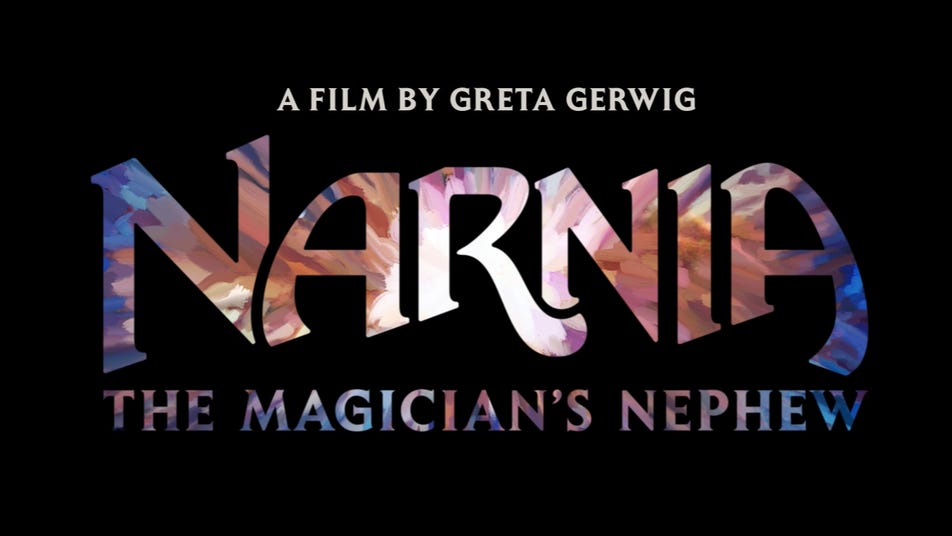
7. Netflix’s Upcoming Narnia Universe (The Magician’s Nephew, 2027)
- Format: Theatrical and Streaming Cinematic Universe (Netflix / Sony Pictures)
- Key Talent: Written and directed by Greta Gerwig; starring Emma Mackey (Jadis / The White Witch), Meryl Streep (Aslan), Carey Mulligan (Mabel Kirke), Daniel Craig, and Kobna Holdbrook-Smith.
- Significance: Netflix’s massive, multi-project reinvention of the IP under filmmaker Greta Gerwig. Eschewing the traditional starting point of The Wardrobe, this iteration officially kicks off with the grand origin story, The Magician’s Nephew.
- Release Dates: Scheduled for IMAX sneak previews on February 10, 2027, a global theatrical release via Sony Pictures on February 12, 2027, and its streaming debut on Netflix on April 2, 2027.
Discover EVERYTHING NARNIA – books, movies and more, via AMAZON.


