There is a popular misconception floating around the internet that J.R.R. Tolkien invented the modern fantasy bestiary out of thin air. While Tolkien undeniably codified how pop culture views Elves, Dwarves, and Orcs, he was not writing in a vacuum. As an Oxford professor of Anglo-Saxon and philology, Tolkien spent his life studying ancient languages, pagan epics, and forgotten folklore.
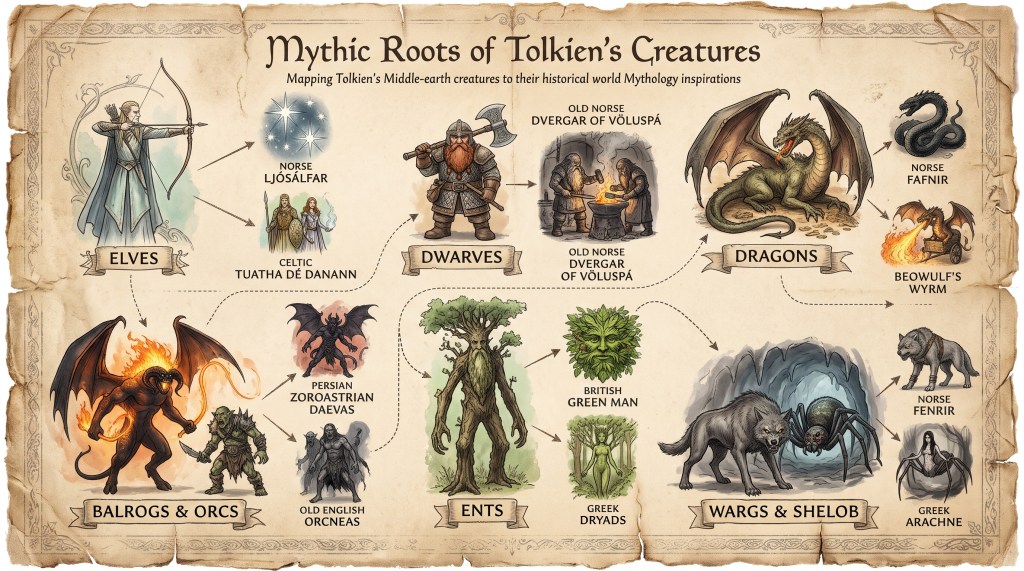
Rather than inventing creatures from scratch, Tolkien acted like a literary alchemist. He took ancient mythological archetypes, chimeras, and spirits indexed by pagan gods across Scandinavia, the British Isles, Greece, and Persia—and fused them with his own Catholic theology of creation and corruption.
Here is a breakdown of the most iconic creatures in Middle-earth, their in-universe origins, and the real-world historical mythologies that birthed them.
1. Elves: From Mischievous Nature Spirits to Angelic Lords
- Tolkien Lore: The Quendi (“The Speakers”) were the Firstborn Children of Ilúvatar, awakening beside the waters of Cuiviénen under starlight. Immortal, wise, and deeply tied to the fate of the earth, they represent the pinnacle of artistic and spiritual grace.
- Historical Roots (Scandinavia & The British Isles): Before Tolkien, “elves” in popular imagination were tiny, mischievous, Victorian fairy-tale sprites. Tolkien reached back past Shakespeare to old Norse mythology (Álfar) and Anglo-Saxon lore. In the Norse Prose Edda, the Ljósálfar (Light Elves) were radiant, god-like beings dwelling in Álfheimr, while Celtic and Irish traditions of the Tuatha Dé Danann and the Sidhe depicted tall, luminous, immortal nobility living in hidden realms across the sea—directly inspiring Tolkien’s Undying Lands of Valinor.
2. Dwarves: Forged in Stone and Norse Eddas
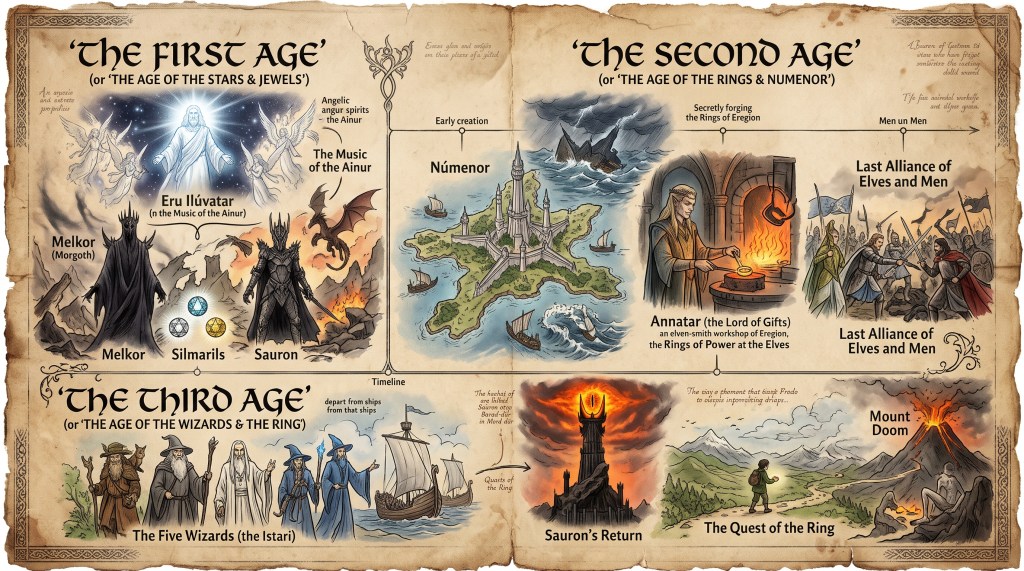
- Tolkien Lore: Dwarves were not part of Eru Ilúvatar’s original musical design. They were sculpted in secret out of stone and earth by Aulë, the Vala of smithing, who grew impatient to teach craft to living beings. Eru later granted them true souls and free will, decreeing they would sleep beneath the mountains until after the Elves awoke.
- Historical Roots (Scandinavia): Tolkien lifted his Dwarves—and nearly all of their names—straight out of the 13th-century Old Norse Poetic Edda (specifically the poem Völuspá). Names like Thorin, Fili, Kili, Balin, Dwalin, Gloin, Gimli, and even Gandalf come directly from an ancient Norse catalog of dwarves. In Germanic and Scandinavian folklore, dwarves (dvergar) were subterranean master smiths who forged magical weapons for the gods (like Thor’s hammer, Mjölnir) and possessed an obsessive, often perilous greed for gold.
3. Dragons: Treasure-Hoarding Serpents of the North
- Tolkien Lore: Because Morgoth could not wield the Secret Fire to create true life, he bred twisted mockeries of existing creatures. Dragons—starting with Glaurung, the Father of Dragons, and culminating in winged fire-drakes like Smaug—were engineered as living siege engines infused with Morgoth’s own malice and hypnotic greed.
- Historical Roots (Scandinavia & Anglo-Saxon England): Smaug is a direct descendant of two legendary northern wyrms: Fafnir from the Norse Völsunga saga (a dwarf-turned-dragon who hoarded cursed gold and spoke in riddles with the hero Sigurd) and the nameless, treasure-guarding dragon from the Old English epic Beowulf, which wakes in a fury and burns a kingdom after a thief steals a single golden cup from its hoard.
4. Balrogs & Orcs: Fallen Fire Spirits and Corrupted Clay
- Tolkien Lore: Balrogs (Valaraukar, “Demons of Might”) are fallen Maiar—angelic spirits of fire seduced by Morgoth at the dawn of time. Orcs, meanwhile, were most famously theorized in-universe to be captured Elves tortured and mutilated by Morgoth in the dark pits of Utumno until they became a ruined, hateful mockery of life.
- Historical Roots (Persian Dualism, Greece, & Old English):
- Persia: Tolkien’s theological framework—where a supreme creator god (Eru) is opposed by a corrupting dark spirit (Melkor) who twists good creations into monstrous shadows—closely parallels ancient Zoroastrian dualism from Persia, where the supreme creator Ahura Mazda battles the destructive spirit Angra Mainyu, who counters every pure creation with a venomous, corrupted counterpart (known as daevas).
- The British Isles & Greece: The word “Orc” comes from the Old English orcneas (found in Beowulf, meaning “corpse-demons” or “underworld monsters”), which itself traces back to Orcus, a Roman/Etruscan god of the underworld. Meanwhile, Balrogs blend Christian fallen-angel theology with the towering, elemental Titans and Gigantes of Greek mythology.
5. Ents & Huorns: The Walking Forests
- Tolkien Lore: When Yavanna, the Vala of growing things, feared that Aulë’s Dwarves would chop down all the trees of Middle-earth, Eru answered her prayer by sending spirits from afar to inhabit the trees—creating the Ents, ancient shepherds of the forest.
- Historical Roots (The British Isles & Greece): Ents are Tolkien’s loving nod to the Green Man archetype of British folklore, the Celtic reverence for sacred groves, and Shakespeare’s Macbeth (Tolkien famously felt cheated as a boy when “Birnam Wood coming to Dunsinane” turned out to be soldiers carrying branches rather than actual walking trees). They also echo Greek Dryads and Hamadryads—tree spirits whose lifespans were inextricably bound to the ancient oaks they inhabited.
6. Wargs, Fell Beasts, & Shelob: Mythic Chimeras and Primordial Horrors
- Tolkien Lore: Middle-earth is populated by terrifying beasts that blur the line between natural predators and demonic spirits: Wargs (demonic, intelligent wolves), Fell Beasts (featherless, leathery winged mounts of the Nazgûl), and Shelob (the last child of Ungoliant, a primordial void-spirit shaped like a monstrous spider that devoured light itself).
- Historical Roots (Scandinavia & Greece):
- Wargs: Drawn directly from the Old Norse vargr (meaning both “wolf” and “outlaw/strangler”) and the monstrous wolf Fenrir, who is prophesied to devour Odin at Ragnarök.
- Fell Beasts: Classic mythological chimeras—echoing the Stymphalian Birds and Harpies of Greek myth, as well as medieval depictions of wyverns and pterosaurs.
- Shelob & Ungoliant: Tapping into universal arachnid dread and classical monsters like Arachne and the multi-limbed horrors of Greek Tartarus, combined with Norse cosmology’s existential fear of cosmic void-beasts gnawing at the roots of the world.
7. Hobbits: The One True Original?
While Hobbits are often hailed as J.R.R. Tolkien’s one truly original creation, they are actually a grounded, humanized remix of classic European gnomes and British household spirits. Tolkien combined the subterranean nature of Renaissance alchemist Paracelsus’s gēnomos (“earth-dwellers”)—trading magical rock-phasing for cozy, luxurious underground smials—with the diminutive, barefoot, food-loving domestic sprites of British folklore, such as Scottish Brownies and English Hobs (the dialect root of the word “Hobbit”). Crucially, where traditional gnomes and fairies were amoral, soulless nature spirits, Tolkien stripped away their magic and grafted them onto the mortal souls of Men, transforming an ancient earth-spirit archetype into the ultimate relatable, middle-class English underdog hero.
Tolkien didn’t need to invent his monsters from nothing; by tapping into the shared mythological bloodstream of Europe and the Near East, he gave Middle-earth the uncanny feeling of a forgotten, real-world prehistory.