When J.R.R. Tolkien created Middle-earth, he didn’t just invent maps and languages; he constructed a vast, theological cosmology that rivals ancient human mythologies. Long before Frodo Baggins carried the One Ring to Mount Doom, the fate of Arda (the Earth) was decided in a timeless void through music, divine fire, and primordial rebellion.
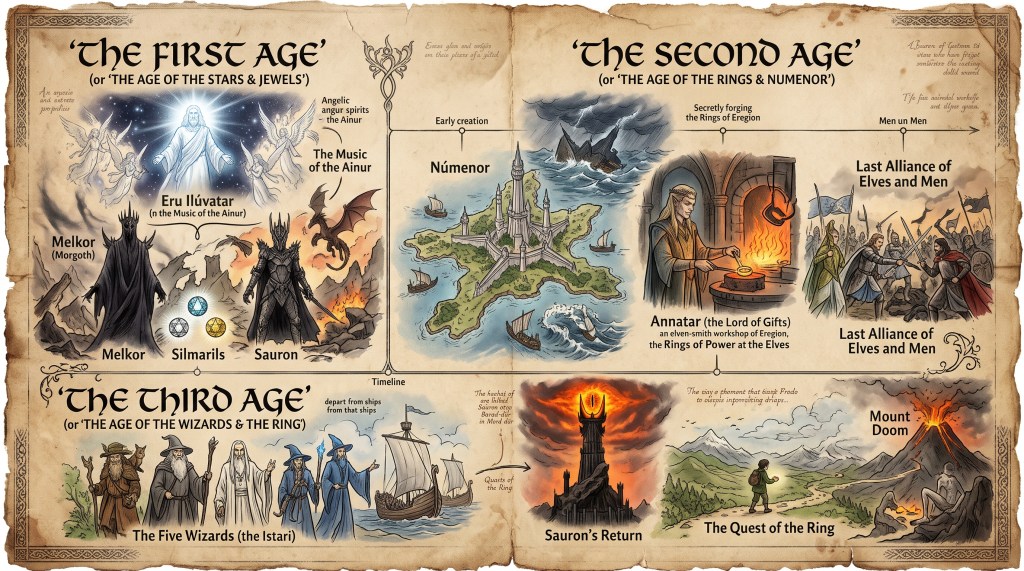
Here is a deep dive into the creation myth of The Lord of the Rings, unpacking the Secret Fire, the original Dark Lord, Sauron’s true nature, and the five mysterious Wizards sent to save Middle-earth.
1. Eru Ilúvatar and the Secret Fire
In the beginning, there was Eru, known to the Elves as Ilúvatar (“Father of All”). He dwelt alone in the Timeless Halls, surrounded by the Void.
At the core of Eru’s creative power is the Secret Fire—also known as the Flame Imperishable. In Tolkien’s mythos, the Secret Fire is the divine spark of creation and true life, analogous to the Holy Spirit in Christian theology. It is the source of independent thought, free will, and the ability to bring genuinely new things into existence out of nothing. Crucially, the Secret Fire resides only with Eru Ilúvatar; no lesser being, no matter how powerful, can wield it independently.
(Fun trivia for film fans: When Gandalf confronts the Balrog on the Bridge of Khazad-dûm in The Fellowship of the Ring and declares, “I am a servant of the Secret Fire, wielder of the flame of Anor,” he isn’t boasting about pyromancy—he is announcing that he is an angelic emissary of God himself!)
2. The Ainulindalë: Singing the Universe Into Existence
From his own thought, Eru created the Ainur (“The Holy Ones”), angelic spirits each gifted with a portion of Eru’s mind. Eru gathered the Ainur and proposed a grand musical theme, instructing them to weave a great symphony together. This cosmic performance is known as the Ainulindalë (the Music of the Ainur).
For a time, the music was harmonious and magnificent. Then, the greatest of the Ainur began to weave his own discordant, self-aggrandizing melodies into the symphony, clashing violently against Eru’s theme. Eru responded by raising new, deeper themes that absorbed the discord and turned it into something unexpectedly profound.
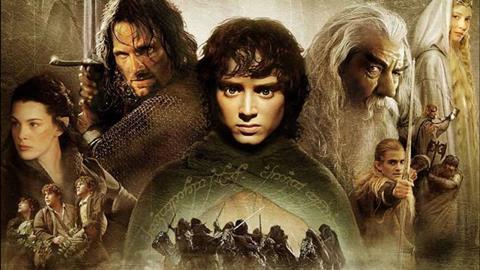
When the music ended, Eru showed the Ainur a vision of what they had sung—a physical world suspended in the Void. He then spoke a single word: “Eä!” (“Let these things Be!”), sending the Secret Fire into the heart of the world to make the vision reality. Many of the Ainur descended into this newly formed universe to shape and govern it, becoming known as the Valar (the great elemental powers of the world) and the Maiar (lesser angelic spirits who served and assisted the Valar).
3. Melkor (Morgoth): The Original Dark Lord
Long before Sauron forged the One Ring, there was Melkor—the mightiest of all the Ainur, gifted with the greatest share of power and knowledge by Eru.
Melkor was the rebel who introduced discord into the Great Music. Driven by pride, envy, and a desperate desire to possess the Secret Fire so he could create his own subjects from scratch, Melkor roamed the Void looking for the Flame Imperishable in vain. Because he could not create true life, he turned to corrupting what Eru and the Valar had made—twisting Elves into Orcs, breeding dragons and Balrogs, and marring the very fabric of the earth.
After Melkor stole the sacred Silmarils (three radiant jewels crafted by the Elves) and murdered the High King of the Noldor, the Elves named him Morgoth, meaning “The Dark Enemy of the World.” Throughout the First Age of Middle-earth, Morgoth waged catastrophic wars against Elves, Men, and the Valar themselves, reshaping continents before he was finally defeated in the War of Wrath and cast out through the Door of Night into the Timeless Void.
4. Sauron: The Dark Lord’s Greatest Lieutenant
If Morgoth was the fallen archangel of Middle-earth, Sauron was his chief general and deadliest successor.
Originally named Mairon (“The Admirable”), Sauron was one of the Maiar—specifically a spirit of immense intellect and craftsmanship who served Aulë, the Vala of smithing and earth. Mairon was obsessed with order, efficiency, and perfection. He despised waste and friction, which ultimately made him vulnerable to Melkor’s seduction; Mairon believed Melkor had the sheer power to enforce absolute, streamlined order across the world.
Following Morgoth’s banishment into the Void at the end of the First Age, Sauron remained in Middle-earth. Over the ensuing millennia, he stepped into his master’s shadow, rebranding himself as the new Dark Lord. Lacking Morgoth’s godlike brute strength to shatter mountains, Sauron relied on deception, manipulation, and sorcery—eventually tricking the Elven-smiths of Eregion into forging the Rings of Power so he could dominate the minds of Middle-earth’s rulers through the One Ring.
5. The Istari: The Five Wizards
Around the year 1000 of the Third Age, as Sauron’s shadow began to stir once more in Mirkwood, the Valar decided to intervene—not with an invading army of angels (which had devastated the continent in the past), but through subtle guidance. They selected five Maiar to cross the sea to Middle-earth as the Istari (known to Men as Wizards).
To prevent them from dominating mortals with raw angelic majesty, the Valar clothed them in the frail bodies of old men, subjecting them to hunger, fatigue, fear, and dimmed memories of their celestial home. Their mission was strictly to advise, unite, and inspire the Free Peoples against Sauron:
- Saruman the White (Curumo): Originally the wisest and leader of the order, also a Maia of Aulë (giving him a dangerous shared affinity for machinery and craft with Sauron). Over centuries of studying Ring-lore, Saruman grew proud, abandoned his mission, and sought to claim the One Ring for himself before falling to ruin at Isengard.
- Gandalf the Grey (Olórin): Wisest of the Maiar in spirit, though seemingly humble and weary upon arrival. Unlike Saruman, Gandalf wandered Middle-earth tirelessly, befriending Elves, Dwarves, Men, and Hobbits alike. After sacrificing himself to slay the Balrog of Moria, Eru Ilúvatar himself intervened, resurrecting and enhancing him as Gandalf the White to finish the task Saruman abandoned.
- Radagast the Brown (Aiwendil): A Maia devoted to Yavanna, the Vala of nature and living things. Upon arriving in Middle-earth, Radagast fell deeply in love with the flora and fauna of the wild, largely abandoning the political struggle against Sauron to tend to beasts and birds—though his network of wildlife occasionally aided Gandalf.
- The Two Blue Wizards (Alatar and Pallando): Known in the East as Morinehtar (“Darkness-slayer”) and Rómestámo (“East-helper”). Together, they journeyed deep into the eastern and southern lands of Middle-earth—regions heavily under Sauron’s sway. Their exact fates remain shrouded in mystery; Tolkien initially mused they may have failed and founded secret magic cults, though in his later writings he credited them with sparking rebellions that prevented Sauron’s eastern armies from completely overwhelming the West.
Through this intricate tapestry—stretching from a primordial choir in the Void down to a humble Hobbit carrying a piece of corrupted gold—Tolkien gave Middle-earth a mythic weight that endures nearly a century after he first put pen to paper.
CLICK HERE Discover the books of J.R.R. Tolkien. Plus TV Shows, Movies, Audio Books & More!