
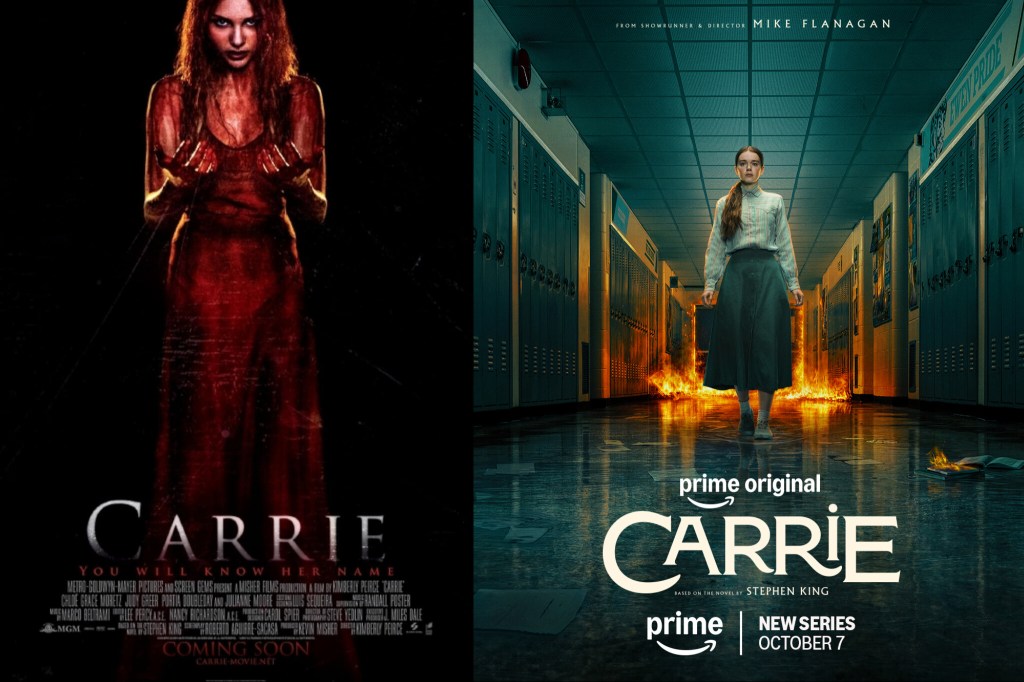
My mind is completely blown. In general, the reviews for Carrie (2026) are stellar. The few I’ve seen complaining are usually not loving the ending or throwing a fit over any changes from the book and the movies. Honestly? They can’t handle Adaptation 101. They want a movie that matches their exact mind’s eye from what they read decades ago.
BUT a writer and director like Mike Flanagan is going to put his own stamp on it. Plus, let’s be real… it’s 52 years later. The world has changed.
There is one line from Adelaide (played by Kate Siegel) that perfectly sums up Mike Flanagan’s whole take:
“The world has changed, Margaret. Folks with powers are finding each other now. And your daughter is going to be part of what comes next.”
Stephen King has always hinted at a tangible connection between the strange abilities his characters possess. He would later call it THE SHINE.
Connecting the Uni-King-Verse: How THE SHINE Scales Up
Think of THE SHINE as Stephen King’s version of the Force in Star Wars or the Mutant Gene in Marvel.
In the 1970s Stephen King world, it made complete sense that isolated cases of kinetic or psychic phenomena around the globe never crossed paths. Characters often self-destructed, got hunted down by witch-hunters, or were swept under the carpet as local legends, ghost stories, or forgotten tragedies because folks were too embarrassed or terrified to share their stories.
Now, imagine that same concept in the age of everything is online a second later. In an era of TikTok, viral cell phone footage, and live streaming, what might look like a local hoax to most is instantly recognized by another person with powers—or by a shadowy government mother who feels victimized by them.
Can the Uni-King-Verse Pull Off What Marvel and DC Are Struggling With?
Let’s talk about the state of comic universes right now. Giants like Marvel and DC are suffering under the weight of bloated multiverse expansion. Their ability to tell grounded, street-level stories has been crushed under the existential dread of “what does it all mean for the doomsday of the cosmos?” (Even when a movie like Supergirl drops as an awesome, character-driven roller coaster, it still feels like a standalone side-step from the ultimate narrative weight).
Can the Uni-King-Verse avoid that trap and actually deliver? Here is how THE SHINE opens the door to a massive, interconnected playground without breaking the storytelling:
- The Firestarter Protocol (The Shop): Just like the government agency “The Shop” hunts down pyrokinetics like Charlie McGee, a connected King-verse can easily weave institutional oversight into the background. The government isn’t fighting a multiverse threat; they are managing a biological baseline anomaly.
- The Dark Tower Nexus: Everything in Stephen King’s bibliography ultimately ties back to the Beams and the Dark Tower. Telekinesis, telepathy, and pyrokinesis aren’t random magic—they are manifestations of touching the higher levels of the tower’s architectural reality. A unified universe lets Flanagan drop subtle cosmic breadcrumbs without needing every character to fight a universe-ending CGI portal in the final act.
- The IT and Deadlights Connection: Derry, Maine, and Chamberlain, Maine aren’t that far apart on a map. Massive localized kinetic trauma acts as a beacon. When Carrie unleashes hell, it doesn’t just burn down a high school; it rips a hole in the veil that ancient, macroversal entities like Pennywise can smell from miles away.
Flanagan is building something rare: a shared cinematic universe that stays deeply character-driven and terrifyingly human, while quietly connecting the dots across King’s entire library.
What do you think? Are you ready to see how far the rabbit hole goes, or do you want these stories to stay in their own backyards? Let’s talk about it below!


