
My mind is blown. I had to stop and share. Below is a recap for the book, movie and WAY below a recap of Episode One: First Period.
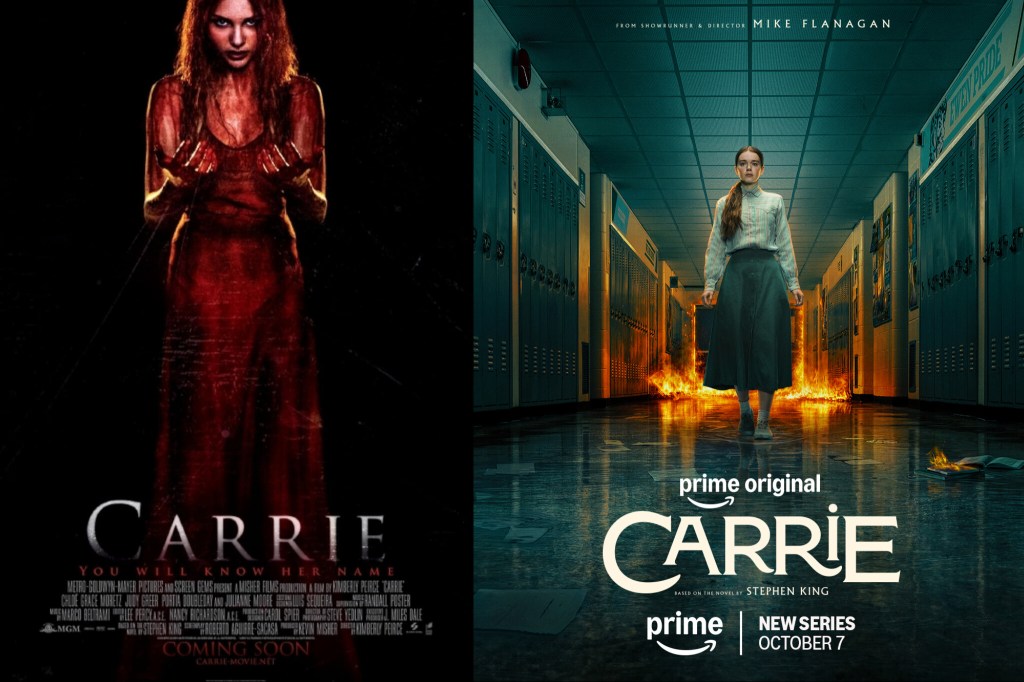
The Book, Original Source Material
Stephen King’s 1974 debut novel Carrie established a chilling blueprint for modern horror. Told through a framing device of government inquiries, scientific reports, news clippings, and book excerpts surrounding a catastrophic town-wide disaster in Chamberlain, Maine, the book explores the telekinetic tragedy of Carietta White. Raised by a violently fanatical and abusive mother, Margaret, Carrie is a bullied, socially isolated outcast whose latent telekinesis erupts under the extreme humiliation of a high school prom prank. The novel leans heavily into themes of religious extremism, teenage cruelty, and the inescapable weight of generational trauma, culminating in an apocalyptic psychic rampage that burns the town to the ground.
The 1970s Movie
Brian De Palma’s legendary 1976 cinematic adaptation starring Sissy Spacek as Carrie and Piper Laurie as Margaret transformed King’s text into a masterclass in psychological horror and stylized suspense. The film tightened the narrative focus primarily around Carrie’s immediate school environment, immortalizing iconic cinematic touchstones—from the slow-motion shower room panic and the agonizingly tense buildup to the prom, right down to the bucket of pig’s blood and the ultimate, heart-stopping jump scare through the ashes. De Palma’s version anchored its terror in raw, intimate teenage cruelty and gothic maternal oppression.
MAJOR SPOILER ALERTS BELOW
Episode 1 Summary: “First Period”
Mike Flanagan’s 2026 television adaptation for Amazon Prime Video radically reframes the familiar mythos. The series opens in media res amidst a smoking, ruined Chamberlain where survivors sit for a post-disaster documentary, hinting immediately that the tragedy was far more complex than just one girl losing control.
The story then rewinds: Carrie White (Summer H. Howell) has lived a life of total isolation. She has no birth certificate, no phone, has never used the internet, and has been homeschooled by her reclusive, religiously fanatical mother, Margaret (Samantha Sloyan), with knowledge extending little beyond the Bible. That isolation shatters when her father, Ralph, dies in a sudden construction site accident. Because the family is left destitute and lacking life insurance, a judge steps in: Margaret is forced to work her first job in 15 years, and Carrie is legally mandated to attend Thomas Ewen Consolidated High School.
Stepping into a modern high school with smartphones, viral social accounts, and active-threat drills is an overwhelming culture shock for Carrie. During a school lockdown drill, her genuine terror triggers her very first flickers of telekinetic power—causing the lights to flicker and a television to crash down.
The episode’s harrowing climax hits in the locker room after gym class when Carrie experiences her first period. Having been kept entirely ignorant of biology by her mother, she panics, believing she is bleeding to death. Chris Hargensen and her peers seize on her ignorance, mocking her, filming her, and pelting her with tampons as she screams. When the lights shatter in a burst of telekinetic energy under the stress, the modern nightmare officially begins.
Theories Based on Other Stephen King Source Material & Extended Lore
(Don’t worry—nothing spoiled past Episode 1 here!)
If you are wondering whether this universe is tapping into broader Stephen King tropes like Firestarter, IT, or other government-oversight deep states, the short answer is: you are tracking exactly the right wavelengths.
While the original Carrie novel is largely a self-contained tragedy about small-town cruelty and telekinesis, Mike Flanagan’s television framework deliberately hints at a much larger, interconnected speculative tapestry:
- The Firestarter Connection (The Shop / Government Oversight): In Stephen King’s bibliography, government fascination with kinetic gifts is heavily cataloged—most notably in Firestarter, which deals with a clandestine government agency known simply as “The Shop” that tracks down and weaponizes people with psychic abilities. Given how the premiere of Carrie opens with documentary framing, state surveillance, and institutional monitoring of reclusive families, it heavily mirrors the shadowy government oversight seen in Firestarter and Firestarter: Reawakened.
- The Ending Tease & The Wider World: Right at the very end of Episode 1, a subtle narrative cue cuts away to another young woman miles away who physically feels the shockwave of Carrie’s awakening power—reacting with chilling recognition. This structural choice expands the narrative away from a single isolated incident and introduces the concept of a wider network, underground community, or suppressed collective of telekinetics. It shifts the vibe slightly away from a standard standalone adaptation and more toward a shared-universe supernatural thriller (akin to X-Men or King’s broader cosmic connective tissue).
- Tapping Into IT and Deadlights Lore: While Carrie traditionally takes place in the grounded, mundane world of high school rather than the cosmic, interdimensional entity-driven terror of Derry, Maine (IT), Stephen King’s universe loves to remind us that “The Dead” and psychic energies operate on a shared plane. Powerful kinetic events in King’s universe often act as beacons, drawing the attention of other forces—or entities that feed on human trauma.
Are you hooked on this modern, sprawling reinvention of Carrie, or do you prefer the tight, isolated terror of the original book and film?


