
For nearly a century, humanity has pointed massive metallic ears toward the dark ocean of the cosmos, straining to catch a whisper that we aren’t alone. From the accidental hums of early radio astronomy to the organized sweeps of SETI (Search for Extraterrestrial Intelligence) and the modern marvels of cutting-edge radio telescopes, our pursuit of deep space “signals” has evolved from a sci-fi fantasy into a hard science.
And as a recent breakthrough proves, the universe still knows how to surprise us—even when the truth isn’t quite what pop culture hoped it would be.
The Dawn of Cosmic Listening: How Radio Waves Opened the Sky
Before we started looking for artificial broadcasts from distant civilizations, we had to discover that the universe itself is naturally noisy. In the 1930s, Karl Jansky—an engineer at Bell Telephone Laboratories—was investigating static that was interfering with transatlantic shortwave voice transmissions. Using a custom-built directional antenna, he isolated a steady, mysterious hiss that wasn’t coming from thunderstorms or Earthly electronics.
The source? The center of our own Milky Way galaxy.
Jansky’s accidental discovery birthed radio astronomy, proving that celestial objects—stars, gas clouds, pulsars, and colliding galaxies—broadcast invisible waves across the electromagnetic spectrum long before humans ever built a transmitter. Suddenly, astronomers realized they didn’t just have to look at the universe with optical telescopes; they could listen to it.
SETI and the Search for Artificial Technosignatures
With a universe full of natural radio noise, a profound question naturally followed: If other intelligent civilizations are out there, how would they talk to us?
The answer seemed obvious: electromagnetic waves. Radio frequency communications travel across interstellar distances at the speed of light, making them the ultimate medium for galactic communication.
This realization led to the birth of SETI (Search for Extraterrestrial Intelligence) in the mid-20th century. Pioneers like Frank Drake launched Project Ozma in 1960, tuning radio telescopes to nearby sun-like stars (Tau Ceti and Epsilon Eridani) to listen for intentional, narrow-band radio signals.
Over the decades, SETI expanded through massive array networks, citizen-science projects like SETI@home, and dedicated observatories. While the search has logged famous anomalies—most notably the “Wow! Signal” detected in 1977, a powerful 72-second narrowband radio spike that set hearts racing before fading into the cosmic background—a definitive, repeating artificial technosignature has famously remained elusive. We are still waiting for our first confirmed “hello” from the stars.
The New Frontier: Tracing Radio Signals to Beta Pictoris b
While SETI hunts for extraterrestrial civilizations, mainstream astronomers continue using radio astronomy to decode the violent, fascinating mechanics of alien worlds. A historic milestone achieved this month proves just how far our detection technology has come.
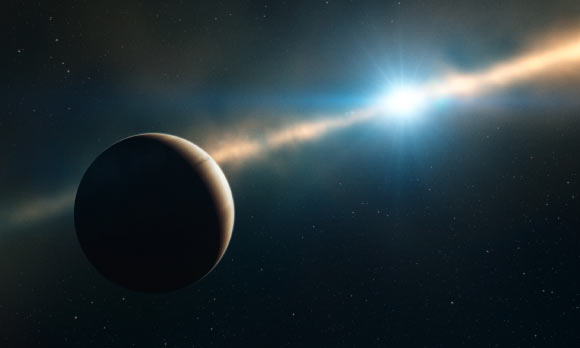
Astronomers using South Africa’s powerful MeerKAT radio telescope array successfully captured short, repeating bursts of radio waves coming from Beta Pictoris b, a massive gas giant exoplanet located roughly 63 light-years away from Earth.
For years, astronomers had detected radio noise from distant star systems, but they couldn’t definitively prove whether the signals were generated by the host star or an orbiting world. By utilizing distant quasars as reference points to map the emissions, researchers confirmed the radio bursts were broadcasting directly from the planet itself.
Is It Aliens?
As exciting as it is to hear a planet broadcasting across the interstellar void, scientists emphasize that this is not a sign of alien life.
Instead, the signals are a natural phenomenon known as electron cyclotron maser radiation—the exact same process that creates auroras (northern and southern lights) on Earth, Jupiter, and Saturn. Because Beta Pictoris b is a young, massive gas giant that rotates at blistering speeds (completing a full rotation in just 8 to 9 hours), its intense magnetic field and charged particles generate roaring auroral radio storms.
This breakthrough allowed scientists to make the first-ever direct measurement of an exoplanet’s magnetic field strength, calculating it to be thousands of times stronger than Earth’s.
The Truth Is Out There—And It’s Still Listening
The story of deep space signals is a dual narrative. On one hand, we search the static for intelligent architects, driven by the eternal hope that we aren’t alone in the dark. On the other hand, by simply listening to the natural physics of the cosmos, we uncover breathtaking realities about alien worlds—measuring magnetic shields on planets 63 light-years away without ever setting foot on them.
The truth may not have introduced us to an alien civilization yet, but every time we tune our telescopes to the dark, we get one step closer to answering the ultimate question: Who—or what—is out there in the noise?


