
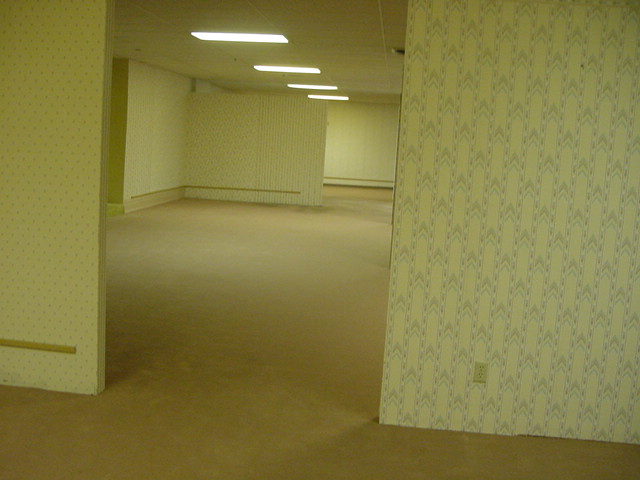
There is a distinct, universal brand of psychological dread that comes from looking at empty, mundane architecture stripped of human life. It’s the feeling of walking down a hotel hallway that feels slightly too long, or staring into an office stockroom that looks identical to the last ten you passed. For years, this quiet unease remained an unspoken quirk of human psychology. Then, the internet turned it into a monster.
The Backrooms have officially evolved from an obscure 4chan post into a massive multimedia empire, culminating in A24’s feature film adaptation. To understand how a photo of a vacant Wisconsin furniture store became one of the definitive horror myths of the 21st century, we have to trace the path from forgotten architectural archives to the silver screen.
The Accidental Origin: Pre-2019 Roots and the Wisconsin Photo
Long before the Backrooms had a name or a mythology, the core building blocks were already floating quietly across the internet.
The famous, aggressively yellow image that spawned a global phenomenon wasn’t computer-generated—it was a real photograph taken back in June 2002. It captured the second-floor interior of a former furniture store (Rohner’s Home Furnishings) in Oshkosh, Wisconsin, while the building was undergoing renovations. Uploaded to a local store remodeling blog in March 2003, the image sat virtually unnoticed for over a decade.
Throughout the 2010s, that photo—alongside similar pictures of empty malls, abandoned airports, and back-of-house commercial corridors—circulated on 4chan boards under the umbrella of “disquieting images.” Fueled by urban exploration (urbex) subcultures and psychological concepts like French anthropologist Marc Augé’s “non-places” (spaces of transience meant to be rushed through, not inhabited), internet users shared a collective, eerie nostalgia for these architectural purgatories. They whispered about “map holes” and spaces that defied physical logic long before a narrative ever materialized.
The 2019 4chan Spark and the Birth of “Noclipping”
The folklore officially kicked off in May 2019 on 4chan’s /x/ (paranormal) board, where an anonymous user paired the 2002 Wisconsin photo with a short, punchy piece of flash fiction:
“If you’re not careful and you noclip out of reality in the wrong areas, you’ll end up in the Backrooms, where it’s nothing but the stink of old moist carpet, the madness of mono-yellow, the endless background noise of fluorescent lights at maximum hum-buzz…”
By introducing the video game concept of “noclipping”—glitching through the physical boundaries of reality—the post gave a name to a cosmic accident. It suggested that our everyday world is fragile, and that an infinite, windowless labyrinth sits just on the other side of the drywall.
From Creepypasta to Collaborative Lore and Video Games
Once the concept hit platforms like Reddit, TikTok, and Twitter, the internet expanded it exponentially. Collaborative wikis transformed a single room into an entire geography of dread divided into numbered Levels (from Level 0’s classic yellow maze to industrial sub-levels and endless concrete deserts), complete with survivalist factions and hostile entities.
Naturally, independent game developers rushed to translate the oppressive architecture into survival horror. Video games like Inside the Backrooms allowed players to physically navigate the endless corridors, manage dwindling sanity meters, and experience the raw panic of being stalked in a space that refuses to end.
The YouTube Revolution and Kane Parsons
The visual identity of the Backrooms took a massive leap forward in 2022 when a 16-year-old creator named Kane Parsons (Kane Pixels) uploaded a lo-fi found-footage short to YouTube. Shot through the lens of a 1990s VHS camera, Parsons followed a cameraman accidentally falling into the yellow void, fleeing organic, shifting entities.
The shorts racked up tens of millions of views, proving that analog horror could rival traditional studio output in atmosphere and tension, and catching the attention of major Hollywood players.
Hitting the Big Screen: A24’s Feature Film Adaptation
That viral trajectory reached its peak with the release of A24’s feature film adaptation of Backrooms. Directed by Kane Parsons himself—transitioning from his bedroom setup to a major studio helm at a historic age—the film expanded his signature found-footage aesthetic into a full-scale cinematic experience.
Bringing the Backrooms to the big screen cemented internet creepypasta as a legitimate, highly influential incubator for modern horror and sci-fi. Ultimately, the Backrooms endure because they tap into a deeply modern brand of isolation: the chilling idea that beneath the boring, predictable structures of our daily lives, there is a vast, indifferent machine—and the exit doesn’t exist.

 Paranormal POV