
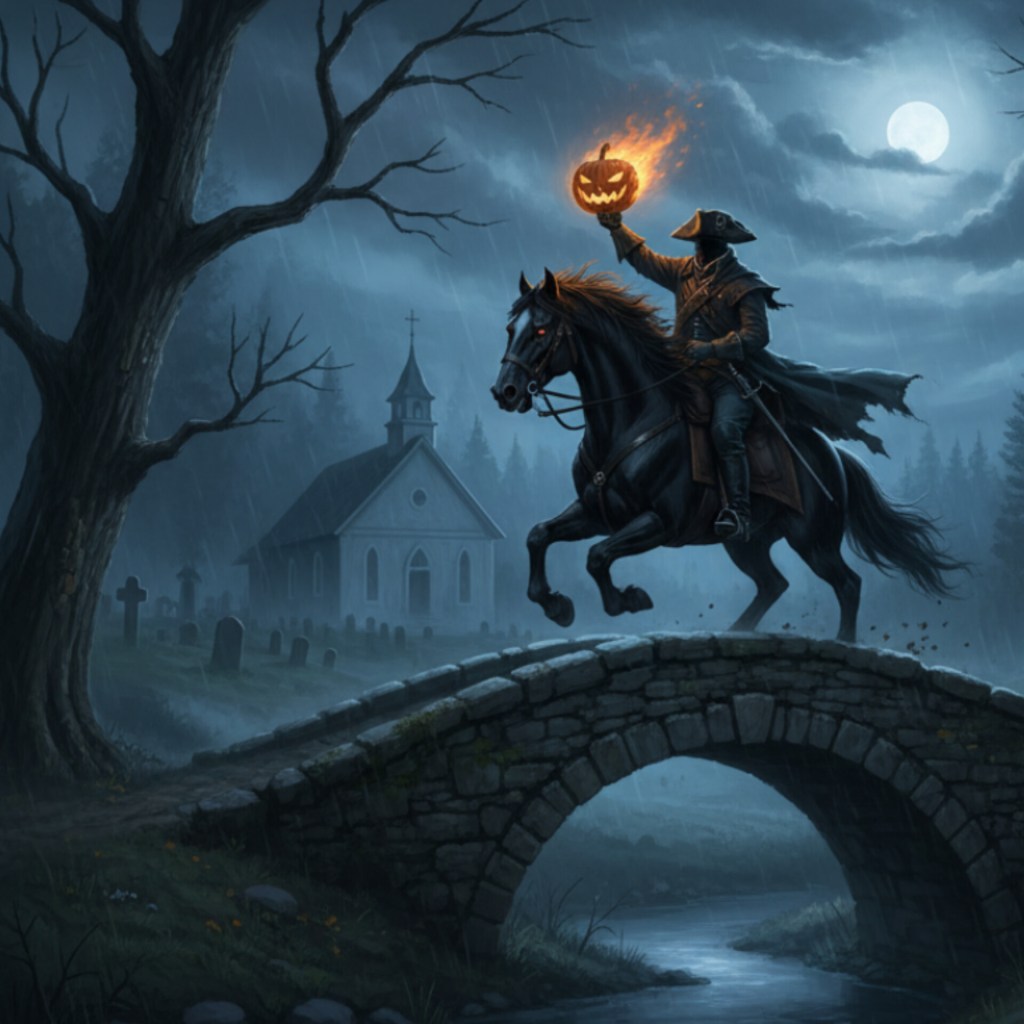
Here is an expanded self-guided tour that includes some of the most notable haunted locations in both Westchester and Dutchess County, highlighting their historical significance and the legends that have made them famous.
A Self-Guided Tour of Haunted Westchester & Dutchess County
Westchester County
1. The Old Dutch Church & Sleepy Hollow Cemetery
- Location: 430 Broadway, Sleepy Hollow, NY 10591 1
- Historical Significance: Dating back to 1685, this is the oldest functioning church and cemetery in New York State. It is the iconic setting for Washington Irving’s “The Legend of Sleepy Hollow” and the burial site for Irving himself, as well as notable figures like Andrew Carnegie and William Rockefeller.3
- Legend: The churchyard is the famed haunt of the Headless Horseman, the ghost of a Hessian soldier who was decapitated by a cannonball during the Revolutionary War.4 The cemetery is also said to contain the unmarked grave of Hulda the Witch, a local folk hero who, according to legend, died fighting the British.6
2. Washington Irving’s Sunnyside
- Location: 89 Sunnyside Ln, Irvington, NY 10533
- Historical Significance: This was the home of author Washington Irving, who penned the classic “The Legend of Sleepy Hollow.”25
- Legend: Irving himself once remarked that if he were to return as a ghost, he would likely haunt his “beloved Sunnyside” but that he would be a “pleasant ghost.”25 While no paranormal activity had been reported for a time, a visitor once claimed to have captured a photo of what appeared to be Irving’s ghost hunched over his writing desk in an upstairs window.25
3. The Church of St. Barnabas
- Location: 15 N Broadway, Irvington, NY 10533 26
- Historical Significance: This stone Gothic Revival church was built in the mid-19th century.26
- Legend: The church and its rectory are allegedly home to two ghostly figures.1 One is a female apparition in Victorian-era clothing who was identified as Mary Isabel Benjamin, the wife of a former rector, and is seen silently knitting in a rocking chair.1 The other is the ghost of the church’s first pastor, Reverend William McVickar, who was seen by workmen installing a new organ in 2000.1 The workers were so unnerved by his presence that they “fled the spooky scene like proverbial bats out of hell.”1
4. The Tarrytown Music Hall
- Location: 13 Main St, Tarrytown, NY 10591
- Historical Significance: Opened in 1885, this is the oldest operating theater in Westchester. It has long served as a cultural hub for the community.7
- Legend: The theater is home to unexplained paranormal activity, with staff and performers reporting lights turning on by themselves and the eerie sound of an unknown singer performing vocal scales in the wings after hours.8
5. Tarrytown House Estate
- Location: 49 E Sunnyside Ln, Tarrytown, NY 10591 10
- Historical Significance: The property is a combination of three Gilded Age estates built in the 19th century.10
- Legend: The estate is said to be haunted by the ghost of Sybil Harris King, who died in the mansion in 1955.10 Guests have reported hearing her footsteps and have seen apparitions.10 Her ghost is also known to interact with modern electronics, with one guest’s phone date allegedly being changed to “1865” and another’s music app repeating the same song.10
6. Weaver Street
- Location: 2 Weaver Street, Scarsdale, NY 21
- Historical Significance: Established in 1924 as the Heathcote Inn, this building has since housed a number of different businesses.27
- Legend: The building is rumored to be cursed, as no business seems to last long at the location.21 It is allegedly haunted by a “murdered working girl” who is often seen on the upper floors.21 Witnesses have also reported seeing the ghost of a man in workman’s clothes staring dejectedly at the building from outside.21
7. Buckout Road
- Location: Buckout Road, between White Plains and West Harrison, NY 12
- Historical Significance: The area is named for an early Dutch family.12 The road’s sinister reputation is linked to a 1644 massacre of over 700 Siwanoy people by English settler John Underhill and a brutal murder committed by Isaac Van Wart Buckhout in 1870.12
- Legend: The site is said to be under a “fiery curse” placed by the Siwanoy ruler, Sachem Pathungo.12 In addition to the vengeful ghost of Isaac Van Wart Buckhout, urban legends of the road include “reclusive albino cannibals,” three witches buried at an intersection, and a “Lady in White” who hanged herself.12 The road has been featured in a horror film, The Curse of Buckout Road, which brought the legend to the big screen.28
8. Copcutt Mansion
- Location: Yonkers, NY 11
- Historical Significance: This was the mansion of the Copcutt family, and its legacy as a haunted location was cemented by an account from a New York detective in 1907.11
- Legend: In a prize-winning account from 1907, a detective named Frederick Hughes described an otherworldly old man who floated down a corridor and through a pair of closed rosewood sliding doors.11 The man, whose cane disappeared into thin air, reportedly shouted: “This place is cursed! The trees will die! Betrayed for money! For money! The old home sold!”11
9. Three Lakes Area
- Location: Lewisboro, NY 2
- Historical Significance: This area is home to the communities of South Salem and Waccabuc, and stories have been passed down for generations about eerie incidents.2
- Legend: Beneath Long Pond Mountain, locals listen for the “Wail of the Wind,” a sorrowful moan attributed to the ghosts of two parents lamenting their son’s drowning.2 The area is also part of the storied route of the “Leather Man,” an itinerant vagabond who mysteriously rambled through the region in the late 1800s, and the “Christmas Soldier,” a Revolutionary-era Patriot who stalks the Highway 22 corridor in Goldens Bridge.2
Dutchess County
10. Bannerman Castle
- Location: Pollepel Island, Beacon, NY (Tours depart from 2 Red Flynn Drive, Beacon, NY 12508)
- Historical Significance: Pollepel Island was used by Frank Bannerman to store military surplus in the early 1900s.13 It was considered haunted by indigenous tribes, who used it as a place of refuge from other tribes.14
- Legend: Native American tribes believed the island was “possessed by evil spirits,” and Dutch sailors later claimed a “tribe of goblins” controlled the surrounding waters, causing ships to sink.15 It is said you can still hear the cries of the crew during storms.15
11. Mount Gulian Historic Site
- Location: 145 Sterling Street, Beacon, NY 12508
- Historical Significance: This site served as the headquarters for General Friedrich Von Steuben during the Revolutionary War.16
- Legend: In 1931, as the house was engulfed in flames, a policeman and three firemen witnessed two spectral figures in 1700s attire—a man hunched over a writing desk and a woman holding a candle.16 The vision, which lasted for nearly 30 minutes, has never been seen again, and their identities remain a mystery.16
12. Vanderbilt Mansion National Historic Site
- Location: Albany Post Road, Hyde Park, NY 17
- Historical Significance: This Gilded Age mansion was once home to the Vanderbilt family and later visited by Franklin D. Roosevelt.17
- Legend: The mansion is reportedly haunted by the spirits of its wealthy residents and those who served them.17 Visitors and staff have heard disembodied footsteps and seen flickering lights.17 The spirits said to linger here include a young cook who met a tragic fate, the ghost of Franklin D. Roosevelt in a ghostly wheelchair, and Eleanor Roosevelt in a flowing gown on the grand staircase.17
13. Abe Lincoln’s Ghost Train
- Location: Hyde Park Railroad Station Museum, 34 River Rd, Hyde Park, NY 12538
- Historical Significance: The Hyde Park Railroad Station Museum is located near the railroad tracks where President Abraham Lincoln’s funeral train passed on April 25, 1865.20
- Legend: According to local lore, the spectral funeral train is said to reappear annually on the night of April 25th.20 Residents have reported hearing the sounds of a train and a lot of noise when no physical train is present.20
14. Fiddler’s Ghost
- Location: Fiddlers Bridge Road and Schultz Hill Road, Staatsburg, NY 12580 22
- Historical Significance: The site marks the former location of a bridge where a local fiddler was robbed and murdered on September 7, 1808.22
- Legend: The ghost of the murdered fiddler is said to still haunt the area, with his music heard “playing a fiddle on moonlit nights.”22 The town of Clinton later named the road in his honor.22
THINGS TO DO
- The Great Jack O’Lantern Blaze: Tour the Van Cortlandt Manor to see a display of over 7,000 illuminated, hand-carved pumpkins. This event runs from September 12 through November 16, 2025.
- Website: https://pumpkinblaze.org/ 1
- Sleepy Hollow Cemetery Walking Tours: Explore the legendary burial ground and final resting place of Washington Irving, Andrew Carnegie, and William Rockefeller. Guided tours include a “Sleepy Hollow Cemetery Lantern Tour” and a “TarryHollow” tour focusing on the area’s history.
- Website: https://sleepyhollowcemetery.org/
- Irving’s ‘Legend’ at the Old Dutch Church: Experience a live, dramatic performance of Washington Irving’s classic, The Legend of Sleepy Hollow, complete with live music, sound effects, and an appearance by the Headless Horseman.3
- Tarrytown Music Hall Ghost Tours: Take a guided tour from the balcony to backstage of this historic 136-year-old theater. Learn about its history and the paranormal activity experienced by performers and staff.4
- Website: https://tarrytownmusichall.org/ghost-tours/ 4
- Bannerman Castle Tour: Take a boat and walking tour of the ruins of this Scottish-style castle on Pollepel Island. The island was considered a place of “evil spirits” by indigenous tribes and later, Dutch sailors.6
- Website: https://bannermancastle.org/
- Vanderbilt Mansion Ghost Tour: Join a guided ghost tour to explore the Vanderbilt Mansion National Historic Site. You will hear chilling tales of its spectral residents, including a young cook who met a tragic end and the ghosts of Franklin and Eleanor Roosevelt.8
- New York State Sheep and Wool Family Festival: Held annually on the third weekend of October at the Dutchess County Fairgrounds in Rhinebeck, this festival features craft vendors, livestock, live music, and family activities.
- Website: https://www.sheepandwool.com/
- Pick-Your-Own Farms: Enjoy a classic fall activity by visiting a local farm. You can pick your own fruits at places like Fishkill Farms or Barton Orchards, which also offers a corn maze, hayrides, and other family-friendly attractions.
- Websites: https://www.fishkillfarms.com/ 10 and https://www.bartonorchards.com/ 11
- Walkway Over the Hudson: Walk, bike, or rollerblade across the world’s longest elevated pedestrian bridge, which offers spectacular views of the Hudson River.
- Website: https://www.walkway.org/
- Old Rhinebeck Aerodrome: Visit a museum of antique aircraft and enjoy weekend airshows that run through October.
- Website: https://oldrhinebeck.org/
The Unseen Hudson: A Comprehensive Inquiry into the Paranormal History of the Hudson River Valley
Introduction: The Hudson Valley as a Nexus of the Unseen
The Hudson River Valley, a region of immense historical and natural significance, is a place where the past feels remarkably close. This proximity is not merely a product of its preserved colonial architecture and Revolutionary War battlefields; it is also a result of a rich, enduring tradition of supernatural folklore and unexplained phenomena. The valley serves as a unique crossroads where historical trauma, cultural identity, and modern superstition converge, creating a landscape that is as much defined by its invisible inhabitants as it is by its physical geography. This report will provide a comprehensive, thematic analysis of the Hudson Valley’s paranormal history, moving beyond a simple catalog of spooky stories to explore the cultural, social, and psychological underpinnings of its most prominent legends. The inquiry will focus on the geographical expanse of Westchester, Dutchess, and Orange counties, as documented by a variety of sources ranging from historical archives and journalistic reports to the findings of modern paranormal investigators. The analysis will demonstrate how the region’s supernatural narrative has evolved over centuries, transforming from a tapestry of historical events and indigenous lore into a modern-day nexus of technological mystery and commercialized hauntings.
The Scars of Superstition: A History of Witchcraft and Accusations
While the Salem Witch Trials of Massachusetts have come to define the popular American understanding of witchcraft hysteria, the Hudson River Valley offers a compelling counter-narrative. The history of witchcraft accusations in colonial New York, particularly in the mid-17th century, is marked by a notable absence of the widespread panic and lethal outcomes seen in its New England neighbors. This divergence is a significant element of the region’s unique supernatural profile, revealing a legal and cultural climate that was a rational check on popular superstition.
The most illustrative example of this is the case of Katherine Harrison, a woman who had already been convicted of practicing witchcraft in Wethersfield, Connecticut, in 1670. The court in Connecticut had exercised discretion by banishing her rather than sentencing her to death, a testament to the severity of her alleged crime.1 Following her banishment, Harrison moved to Westchester to live with her daughter. It was an unassuming new chapter that was soon complicated by a property dispute with her daughter and fueled by the local community’s concern over having an accused witch in their midst.1 Townspeople quickly submitted a petition against her, demanding her removal. However, Governor Francis Lovelace of New York refused to act on the public’s demands. Instead, he deferred the matter to the Court of Assizes, the highest court of the colony, which ultimately exonerated Harrison of any wrongdoing. The court’s decision allowed her to remain in Westchester without interference from the law, though sources note that her legal innocence did not persuade her neighbors, who continued to harbor complaints against her.1 This account of due process and a reasoned legal judgment is a pivotal departure from the swift and often mob-driven justice witnessed in other colonies, demonstrating a foundational skepticism that set New York apart.
A century and a half later, a similar, albeit farcical, accusation would surface in the post-colonial era. The story of Jane Kanniff, the alleged “Witch of West Nyack,” illustrates how folklore can serve as a manifestation of social anxiety. Kanniff was a twice-widowed, aged woman living in an unpainted, rickety house on the social periphery of a community tightly bound by ties of blood and marriage.2 The accusations against her were not of grand malfeasance but rather of minor, accumulated misfortunes, such as housewives being unable to churn butter and finding a horseshoe branded into the bottom of their churns.2 These petty grievances suggest that the community’s fear was not of powerful, malevolent magic but of a person who did not conform and could be blamed for small, inexplicable hardships. The community held a secret meeting to subject her to the ancient and deadly “dunking test,” a practice where a witch who floated was guilty and executed, while one who sank and drowned was innocent.2 The ordeal was prevented by an intervening group, leading to a bizarre alternative trial where she was weighed against a Bible at a grist mill. When she weighed more, she was released.2 Despite her acquittal, the community’s suspicions were posthumously validated by folklore; a short time later, a child of one of her persecutors was gruesomely killed at the very mill where the trial was plotted, an event immediately attributed to Kanniff.2 The persistence of this narrative shows how a community’s belief can endure even in the face of legal and rational disproof.
In contrast to these historical figures of persecution, the legendary figure of Hulda, the “Witch of Sleepy Hollow,” represents a modern reappropriation of the archetype. Hulda is a figure of pure folklore, with no historical record of her existence prior to her introduction in local lore.3 Said to be a “high German” doctor, she was initially denounced as a witch by the local minister but used her powers to heal the sick by leaving baskets of herbs on doorsteps.3 The most significant detail in her legend is her death while fighting the British in the Revolutionary War.3 Her death transforms her from a symbol of fear into a patriotic heroine, integrating the figure of the witch into a foundational moment of American identity. This evolution shows how society’s perception of “witches” can shift over time, from an object of fear to a celebrated local icon, as evidenced by the modern festival founded in her honor by a self-proclaimed “Witch of Sleepy Hollow”.3
| Witchcraft Cases & Legends | Time Period | Location | Historical vs. Folkloric | Social Position | Nature of Accusation | Outcome |
| Katherine Harrison | 1670 | Westchester, NY | Historical (documented) | Widowed, accused outcast | Practicing witchcraft | Exonerated by Court of Assizes, but community complaints continued 1 |
| Jane Kanniff | 1815-1816 | West Nyack, NY | Historical (documented) | Aged, twice-widowed, marginalized | Ruining butter, causing mischief | Acquitted by “weighing against a Bible,” but folklore claimed her revenge 2 |
| Hulda the Witch | c. 1770s | Sleepy Hollow, NY | Folkloric (legendary) | Healer, outsider | Witchcraft | Died a patriotic hero in the Revolutionary War 3 |
Echoes of the Past: Ghosts of Conflict and Community
The supernatural lore of the Hudson River Valley is inextricably tied to its historical landscape. The region’s history of war, land disputes, and violent crimes has left an indelible mark, making it a “psychic battlefield” where spectral activity is a direct echo of past events. The ghosts of the Hudson Valley are not random apparitions but rather embodiments of its historical narrative.
The most compelling case of this is the 1931 fire at the historic Mount Gulian house in Beacon, New York. The original structure, which served as the headquarters for General Friedrich Von Steuben during the Revolutionary War, was engulfed in flames.4 As the fire consumed a wing of the house, a policeman and three firemen witnessed a remarkable sight: two figures, dressed in 1700s attire, in an upstairs room.4 They watched, mesmerized, for nearly half an hour as a man frantically wrote at a desk while a woman held a candle over his work. The vision vanished only when the room was consumed by a shower of sparks and collapsing timbers.4 The story of these two figures, seemingly reliving an urgent, secret moment from the Revolutionary War, perfectly illustrates how the trauma of a historical period can manifest as a persistent haunting. This is not an isolated event but a recurring pattern in the region, with the “legally haunted” house in Nyack reportedly plagued by Revolutionary War poltergeists.5
The legends of Buckout Road in White Plains further demonstrate the layered nature of this historical haunting. The road’s sinister reputation is built upon a foundation of historical fact, indigenous lore, and modern urban legend. It is named after the Buckhout family, one of whom, Isaac Van Wart Buckhout, committed a brutal double murder in 1870, becoming the last person sentenced to hang in Westchester County.6 The legend that his ghost wanders near his unmarked grave provides a direct link between a documented historical crime and a spectral presence.6 This historical grounding is compounded by far older legends, such as the fiery curses of Sachem Pathungo and Sachem Cockensenko of the Siwanoy people.6 The curses were allegedly placed on the land in revenge for the slaughter of over 700 people and for the violation of a treaty.6 It is rumored that the curse lingered over the farming village of Kensico, which was later flooded to create the Kensico Reservoir.6 This stratification of folklore—from ancient indigenous curses and historical crimes to later, more lurid tales of “albino cannibals” and witches—shows how a location with a genuine, dark history can become a magnet for an accumulation of sensationalized stories.6
Beyond these well-known tales, the valley’s history is peppered with fascinating, lesser-known haunts and legends. The story of “Silent Pete,” a real historical recluse from the 1920s and 30s, reveals how folklore can be born from reality and cemented into local identity.8 Pete’s silent, daily walks along the river towns of southern Westchester became the subject of wild speculation, with residents concocting theories about his life and wealth.8 This phenomenon demonstrates that the creation of folklore is not a distant, historical process but an ongoing one, a way for a community to interpret and mythologize its most mysterious inhabitants.
The integration of these ghost stories into the region’s commercial and cultural fabric is a significant modern development. The Hudson Valley has not only preserved its ghost stories but has actively commercialized them, turning the paranormal into a key part of its local identity and tourism.9 The existence of a “Haunted History Trail,” ghost tours at historic locations like the Morris-Jumel Mansion, and even private paranormal investigations at historic homes shows that these narratives have become valuable economic assets.9 This commercialization is a form of cultural heritage preservation, where the eerie and the unexplained are actively promoted, ensuring their stories continue to be told and experienced.
Unidentified Aerial Phenomena: Lights in the Hudson Valley Sky
The Hudson Valley’s paranormal identity, once rooted in its colonial past, took a significant turn in the 1980s with a series of mass UFO sightings known as the “Westchester Boomerang” flap. This event shifted the region’s supernatural narrative from one defined by historical ghosts to one dominated by modern, technological mystery. The widespread sightings placed the Hudson Valley on the national map of ufology and provided a new, distinctly contemporary chapter to its history of the unexplained.
From March 1983 through the summer of 1984, thousands of residents and law enforcement officers in Westchester, Dutchess, and Putnam counties reported seeing a large, V-shaped or circular object in the sky.12 The objects were described as being the size of an American football field, “absolutely noiseless,” and outlined in brilliant, changing lights of white, red, and green.12 Notable accounts include those from Officer Andi Sadoff of the New Castle Police, who saw a series of silent, hovering lights, and Ed Burns, an IBM computer engineer who described a “triangular ship” that he believed was “not from this planet”.13 Other reports, such as a 900-foot UFO hovering over the Indian Point Nuclear Power Plant for 15 minutes, added to the mystique and gravity of the event.12
The widespread nature of the sightings and the credibility of the witnesses sparked a heated public and media debate, pitting a rational explanation against an extraterrestrial one. The official explanation, disseminated by a state police officer, was that the sightings were a hoax perpetrated by local stunt pilots flying Cessna 152s in tight formation.12 The police report indicated that the planes’ undersides were painted black and were rigged with bright, changing lights that, from the ground, would give the impression of a single, massive object. The pilots reportedly found great amusement in the confusion they caused.12 This explanation was supported by an air traffic control specialist who noted that from his vantage point, a tight formation of planes would appear as “just one big light”.13
However, this explanation was not enough for many eyewitnesses and UFOlogists. They pointed to contradictory evidence, such as the numerous reports of the objects being “absolutely silent,” which is inconsistent with the sound of small aircraft.12 A video recorded by Brewster resident Bob Pozzuoli was analyzed by photographic experts who concluded that the footage showed a “single, rigid object,” not a formation of individual planes.13 UFOlogist Philip Imbrogno noted that the “UFO was surely seen before these hoaxster pilots began their night flights,” and that some witnesses noted a clear difference between the mysterious objects and the later-seen airplanes.13 The fact that technology, in the form of rigged lights and a video camera, was both the source of the mystery and the tool used to seek its explanation highlights a central paradox in modern paranormal inquiry. The Hudson Valley UFO flap is a perfect example of how new technologies can create new forms of phenomena and, in turn, new avenues for both investigation and debunking.
The legacy of the UFO flap is a testament to its power to shape a community’s identity. The widespread sightings transformed the small hamlet of Pine Bush, New York, into the “UFO Capital of the East Coast”.10 The town has fully embraced this identity, hosting an annual Pine Bush UFO Fair and establishing the Pine Bush UFO & Paranormal Museum, which offers self-guided and exclusive tours.10 This transformation from a spooky anomaly into a tourist attraction parallels the commercialization of the region’s historical haunts, demonstrating that both ancient legends and modern mysteries can be leveraged for cultural and economic gain.
| Notable Hudson Valley UFO Sightings (1983-1984) |
| March 17, 1983 – Brewster, NY: Dennis Sant and his family see a “very large,” silent, “girder-type looking” object with “iridescent” lights. It is described as a “city of lights” that hangs in the sky.13 |
| March 1983 – New Castle, NY: Officer Andi Sadoff sees a large object with alternating green and white lights that approaches his vehicle, stops, and hovers silently.13 |
| March 1983 – Taconic Parkway, NY: Ed Burns, an IBM engineer, sees a “triangular ship” as large as a football field, which he states “was not from this planet.” His radio experiences static.13 |
| June 14 & July 24, 1984 – Indian Point Nuclear Power Plant: According to UFOlogist Philip Imbrogno, guards witness a 900-foot UFO hovering over the plant for 15 minutes.12 |
| July 24, 1984 – Brewster, NY: Bob Pozzuoli videotapes lights that appear to be a single object rotating counter-clockwise, with no audible sound.12 |
| August 20, 1984 – Mahopac, NY: Irene Lunn reports a sighting of an L-shaped structure “three-quarters the size of my house” with changing lights, with no sound other than crickets.12 |
The Confrontation with Darkness: Demonic Beliefs and Exorcism Accounts
The user’s query specifically requested an exploration of demonic and exorcist events. This is a crucial element of the report, as it highlights a notable absence in the Hudson Valley’s documented paranormal history. Unlike the region’s rich tradition of ghosts, witches, and UFOs, there is a striking lack of documented, local demonic possession or exorcism cases. This omission is not a gap in research but a significant data point that defines the region’s unique supernatural profile.
The most famous American exorcism case, the story of “Roland Doe,” which inspired William Peter Blatty’s novel The Exorcist, is often referenced in discussions of demonic phenomena but has no direct geographical link to New York.14 The case, which allegedly took place in the late 1940s, was centered on a 14-year-old boy from Cottage City, Maryland, and his exorcism was performed by Catholic priests in Washington, D.C..14 While the case was sensationally publicized, it was also shrouded in skepticism, with one of the last surviving eyewitnesses, Father Walter H. Halloran, stating that definitive proof of possession was “unattainable”.14
The fact that the Hudson Valley’s supernatural lore does not contain similar stories reveals a fundamental difference in its paranormal identity. The region’s haunting narratives are tied to historical events and social anxieties, such as the trauma of war, the lingering effects of land disputes, and the ostracization of social outcasts.6 In contrast, the “Roland Doe” case is a deeply theological and sensationalized narrative about the physical manifestation of a malevolent entity, framed within a religious context of good versus evil.14 The absence of similar accounts in the Hudson Valley suggests that the region’s supernatural beliefs are more aligned with secular, historical narratives than with a theological framework of demonic forces. The Hudson Valley’s ghosts are an echo of human suffering and unresolved historical conflict, not a battle against an extra-dimensional evil.
Modern Paranormal Investigation: The Pursuit of Proof
The modern era has brought a new dimension to the Hudson Valley’s paranormal scene: the attempt to apply scientific methodologies to phenomena that are, by definition, unprovable. This contemporary movement of “ghost hunting” blends empirical tools with spiritual belief, creating a form of “techno-mysticism” that is a key characteristic of the current paranormal landscape.16
Modern investigators, such as the Eastern Connecticut Paranormal Society, utilize a range of technical devices, including digital audio recorders for Electronic Voice Phenomena (EVP), EMF meters, and night vision cameras, while also employing traditional, esoteric methods such as relying on “spiritually-gifted individuals”.16 The use of these tools is an attempt to quantify the unquantifiable, such as the belief that “cold spots”—sudden drops in ambient temperature—are a sign of spirit activity.16
While the tools may be technological, the interpretation of the “evidence” they produce remains highly subjective. The provided accounts of EVP recordings from a paranormal investigator in Westchester County perfectly illustrate this point. The investigator captured a clip of a “little girl counting to three” after he had already “intuitively felt” that the spirit of a little girl was in the house.18 Another clip, captured during a “clearing” ritual, contained a high-pitched voice saying, “Please Help Me”.18 A third clip recorded a male voice saying, “Leave that there,” after a piece of wallpaper appeared on the floor of a bedroom.18 In each of these cases, the “meaning” of the EVP is not self-evident; rather, it is derived from the investigator’s prior intuition or the anecdotal context of the event. This cause-and-effect chain—where a pre-existing belief or story is retroactively supported by a sound recording—underscores that these are not objective findings but rather part of a narrative constructed by the investigators themselves.
Despite the subjective nature of the evidence, these investigations have become a significant part of the Hudson Valley’s paranormal culture, with groups offering their services to clients and collaborating with historical organizations to conduct public ghost hunts.11 This symbiotic relationship between modern paranormal inquiry and historical preservation further solidifies the paranormal as a living, breathing tradition in the region, a means for people to actively engage with the past and seek their own proof of the unseen.
| Select Documented Paranormal Evidence in Westchester County |
| Child Counting to Three – Private Home: A ghost hunter, having felt the presence of a little girl, records an EVP of a child’s voice counting to three.18 |
| Please Help Me – Private Residence: An EVP is recorded during a “clearing” ritual, featuring a high-pitched voice asking for help.18 |
| Leave That There – Private Residence: During an investigation, an EVP of a male voice is recorded saying “Leave that there,” apparently in reference to a piece of wallpaper found on the floor.18 |
| Water Pooling on Stairs – Tarrytown Inner Village: Residents of a house report hearing the sound of someone tripping down the stairs and repeatedly seeing water pooling at the top of the stairs.3 |
Conclusion: The Blurring of Fact and Folklore
The paranormal history of the Hudson River Valley is a rich and complex tapestry woven from threads of historical fact, collective folklore, and personal belief. It is a narrative that has continuously evolved, absorbing the anxieties and mysteries of each new era. The region’s history of witchcraft demonstrates a foundational skepticism, where a legal system served as a rational check on popular hysteria, in stark contrast to its New England counterparts. The valley’s ghost stories are not random specters but are intrinsically tied to historical trauma and land conflict, acting as a direct echo of its Revolutionary past. The UFO flap of the 1980s marked a significant shift, placing the region at the center of a technological mystery that has since been commercialized as a source of local identity and tourism.
A key point that must be emphasized is the striking absence of documented demonic possession narratives in the region’s historical and contemporary lore. This absence suggests that the Hudson Valley’s supernatural beliefs are primarily secular and historical, rooted in human events and social dynamics rather than a theological framework of good versus evil. Ultimately, the Hudson Valley’s paranormal history is not merely a collection of isolated stories but a living tradition that blurs the lines between verifiable historical fact and sensationalized folklore. It is a means for a community to interpret its past, grapple with its anxieties, and ultimately define its unique identity in a world where the unexplained remains a powerful and enduring force.


 Paranormal POV
Leave a comment