
This tour is designed to take you through some of the most historically significant and paranormally active locations in and around Richmond. The sites are organized to provide a logical flow, beginning with the city’s urban legends and historical hauntings before venturing out to the battlefields.
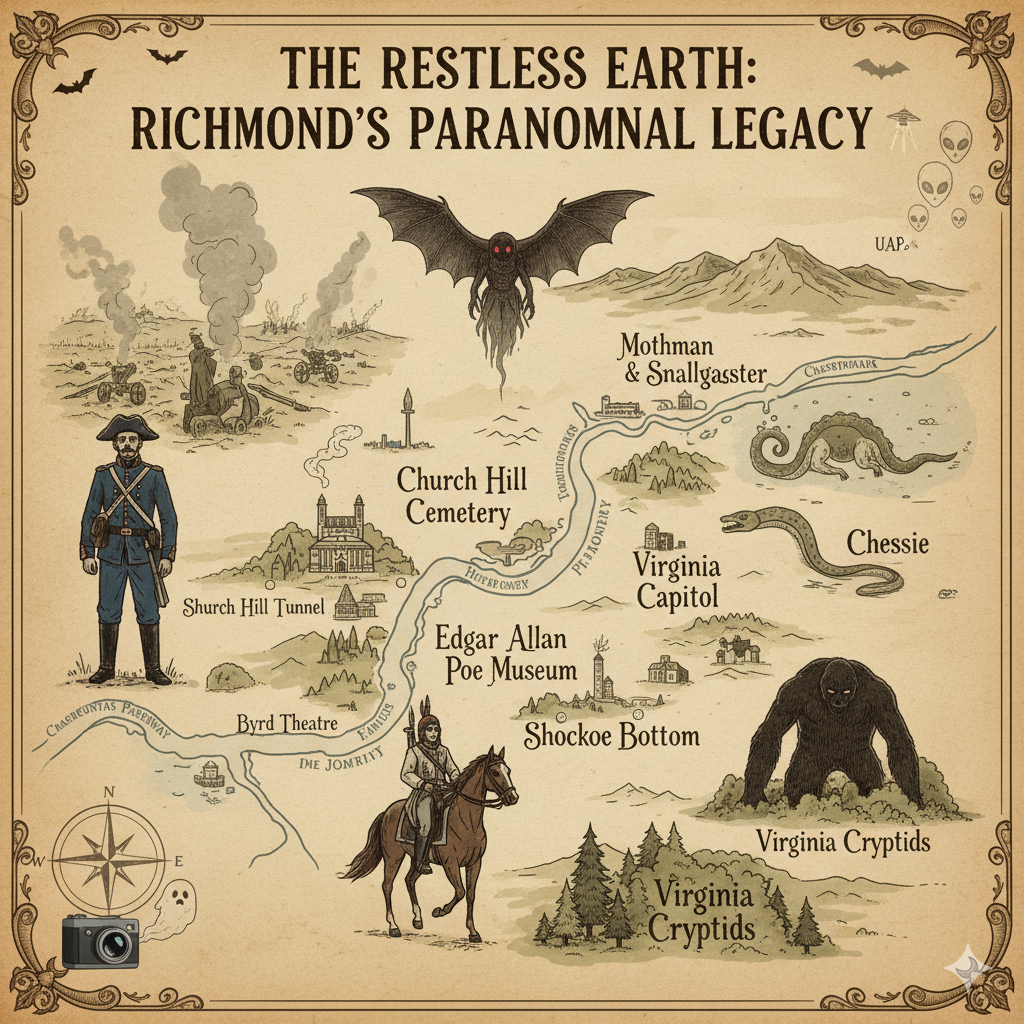
Self-Guided Paranormal Tour of Richmond, Virginia
Please be respectful when visiting these sites, as some are residential or active historical locations.
Stop 1: The Church Hill Tunnel & The Richmond Vampire
- Location: The western portal of the tunnel is visible at North 18th Street, next to the Atrium Lofts at Cold Storage in the Church Hill district. The tunnel itself is not accessible to the public due to its collapse.[1]
- Historical Impact: Constructed in the 1870s, the Church Hill Tunnel was meant to improve the city’s railway system but became infamous on October 2, 1925, when it collapsed.[2, 3, 4] This tragedy killed several workers, some of whom were never recovered.[1]
- Paranormal Legend: The collapse is the focal point of the urban legend of the Richmond Vampire.[2] Witnesses claimed a “blood-covered creature with jagged teeth” emerged from the wreckage, running towards the James River before disappearing into the mausoleum of W. W. Pool in Hollywood Cemetery.[5, 2] However, the “creature” was, in fact, Benjamin F. Mosby, a 28-year-old fireman who was horribly scalded when the locomotive’s boiler ruptured.[2] The legend of the vampire, which existed before the tunnel collapse, merged with this real-life tragedy.[2]
Stop 2: Hollywood Cemetery
- Location: 412 South Cherry Street, Richmond, VA 23220.[6, 7]
- Historical Impact: Hollywood Cemetery, opened in 1849, is the final resting place for two U.S. Presidents, thousands of Confederate soldiers, and Confederate President Jefferson Davis.[5, 8] Its history is deeply intertwined with the Civil War, and the pyramid monument honors the 18,000 Confederate soldiers buried there.[5]
- Paranormal Legends: The cemetery is the site of three primary legends:
- The Richmond Vampire: The mausoleum of W. W. Pool is said to be the vampire’s final resting place.[2]
- The Pyramid: Visitors and groundskeepers have reported hearing soft moans from the 90-foot-tall granite pyramid monument, believed to be the cries of unidentified soldiers who never found peace.[5]
- The Little Girl and Her Guardian: The grave of a three-year-old girl named Rees, who died in 1862, is marked by a cast-iron statue of a dog.[5] People have claimed to see a spectral girl playing with a dog near her grave late at night, and groundskeepers report hearing a dog barking or growling at times.[5] The statue itself is also said to move on occasion.[5]
Stop 3: Edgar Allan Poe Museum
- Location: 1914 East Main Street, Richmond, VA 23223.[9, 10]
- Historical Impact: The Poe Museum is located in the Old Stone House, the oldest building still standing in Richmond. It honors Edgar Allan Poe, who lived and worked in the city and was inspired by its streets for his macabre stories.[11]
- Paranormal Legend: The museum has been considered haunted since the 18th century, when the Ege family lived there.[1] Paranormal investigators have reportedly heard the voices and footsteps of children running up the stairs.[1] Some believe Poe himself still reclines on his favorite sofa after hours.[11]
Stop 4: Virginia Supreme Court Building
- Location: Part of the Virginia State Capitol Complex, at 1111 Capitol Street, Richmond, VA 23219.[12, 13]
- Historical Impact: The building’s haunted reputation is linked to two major tragedies.[14] The first was the collapse of the second-floor gallery on April 27, 1870, which resulted in 62 deaths and 250 injuries.[14] The second was a fatal gunfight in February 1972, when the building served as a Federal Reserve Bank, in which a security officer was killed.[14]
- Paranormal Legend: Unexplained phenomena are frequently reported, particularly on the sixth floor and in the sub-basement levels.[14] Capitol Police officers have reported seeing shadow figures, smelling cigars where no one is present, and one officer felt an “intense icy-cold sensation” on her neck after seeing a shadowy apparition in a brown suit.[14]
Stop 5: Byrd Theatre
- Location: 2908 West Cary Street, Richmond, VA 23221.[15, 16]
- Historical Impact: The Byrd Theatre, a historic movie palace, has been a central part of the Carytown district since 1928.[1]
- Paranormal Legend: The theater is said to be haunted by two spirits.[1] The ghost of a little girl reportedly haunts the women’s bathroom, while the spirit of Mr. Coulter, a former manager, is often spotted in the balcony.[1]
Stop 6: Lumpkin’s Slave Jail Site
- Location: Located on Wall Street in the Shockoe Bottom district, now the area of 1509-1547 East Broad Street.[17]
- Historical Impact: Known as “the Devil’s Half Acre,” this site was one of the largest and most notorious slave-trading facilities in the United States, in operation from the 1830s until the end of the Civil War.[17, 18, 19] It was owned by Robert Lumpkin, who was known for his violence.[19] The building was later torn down and covered with dirt, but its foundations remain beneath the ground.[19, 20]
- Paranormal Legend: The site is described as eerie even in broad daylight, and more disturbing at night.[11] While specific haunting accounts are not detailed in the available research, its history of immense human suffering makes it a prime location for paranormal activity.[19, 20]
Stop 7: Byrd Park Pump House
- Location: 1708 Pump House Drive, Richmond, VA 23221.[21, 22]
- Historical Impact: This Victorian Gothic structure, originally a water pumping facility, was built in the 1880s and closed in 1924.[23] It was saved from demolition and is now part of Byrd Park.[23]
- Paranormal Legends: The Pump House is widely considered one of the most haunted places in America, with numerous ghosts reportedly present.[1, 23] A paranormal expert believes its unique combination of steel, iron, slate, and water makes it a “portal” to the other side.[23] Spirits reported include a woman named Elizabeth, who appears as a floating orb of light, and a woman in white named Spectra.[23] The ghost of a man who committed suicide in the building, Daniel Tetweiler, is also said to haunt the location.[23]
Stop 8: Cold Harbor Battlefield
- Location: Cold Harbor Battlefield Visitor Center is at 5515 Anderson-Wright Drive, Mechanicsville, VA 23111.[24, 25]
- Historical Impact: The Battle of Cold Harbor in June 1864 was a catastrophic military engagement where Union and Confederate soldiers fought for two weeks, leaving nearly 20,000 men dead or wounded.[26]
- Paranormal Legends: The battlefield is famous for its ghostly activity. Reports include:
- Apparitions: Ghostly apparitions of Civil War soldiers are frequently seen wandering the grounds.[26]
- Disembodied Sounds: Visitors hear the sounds of cannon fire, screams, and the panicked neighing of horses.[26]
- A Haunting Scent: The distinct smell of burned gunpowder is often reported.[26]
- Unnatural Fog: A thick, unexplainable fog is said to appear and disappear suddenly.[26] Some speculate this is a psychic echo of the gun smoke from the battle, while others suggest it is a “portal between worlds”.[26, 27]
- The Garthright House: Located near the battlefield, this home was used as a field hospital where the Garthright family reportedly watched blood drip through the cracks in the floor.[26] While no specific haunting stories are available for the house, its history suggests a lasting spiritual imprint.[26]
Stop 9: Pocahontas Parkway
- Location: The Pocahontas Parkway (VA State Highway 895) is a toll road that runs from Interstate 95 to Interstate 295.[28] The most intense phenomena are reported near the toll plaza.[29]
- Historical Impact: Construction of the parkway in 2002 disturbed an ancient Native American burial ground.[28] Archaeological digs revealed a significant area inhabited by the Powhatan and Arrohatak tribes for over 6,000 years, with the toll plaza built directly on a burial ground.[29, 28]
- Paranormal Legends: This is considered a site of spiritual protest by the Indigenous people against the desecration of their land.[29, 28] Reported phenomena include:
- Spectral Warriors: Apparitions of Native American warriors on horseback are commonly seen at night, appearing and vanishing suddenly.[29, 28]
- Auditory Phenomena: Local residents reported hearing war drums, chanting, and whoops long before the parkway was built, and these sounds reportedly intensified after its completion.[28]
- Ghost Cars: Toll workers and police officers have reported hearing the sound of approaching vehicles and even feeling a rush of air, but seeing no car pass through the toll booths.[29, 28]
- Other Figures: Reports include shadowy figures passing through buildings, objects moving on their own, and a truck driver seeing three men in traditional attire holding torches in the middle of the road.[29, 28]
The Restless Earth: A Deep History of the Paranormal in Richmond, Virginia
The American experience is often told through its historical landmarks, but in Richmond, Virginia, the narrative is not confined to the pages of textbooks. Here, the past is not merely a collection of dates and names; it is a living, breathing force that leaves its mark on the land itself. From the earliest days of European settlement to its pivotal role as the capital of the Confederacy, Richmond has been a witness to profound tragedy and conflict. It is within this crucible of human emotion and historical upheaval that its rich paranormal landscape was forged. The paranormal history of Richmond and its surrounding counties is not a simple catalog of ghost stories, but a complex and evolving tapestry of legends, hauntings, and inexplicable phenomena that mirrors the city’s deep and often tumultuous past.
The story begins long before the American Revolution, with the Indigenous peoples who first inhabited this land. European settlers first established a foothold in the region in the early 17th century, but the land itself held a spiritual significance that was millennia in the making.1 These ancient roots are at the heart of one of the most compelling paranormal stories in modern Virginia. In 2002, during the construction of the Pocahontas Parkway, archaeological digs revealed a site that had been inhabited by the Powhatan and Arrohatak tribes for over 6,000 years.2 The new toll road, intended to connect major interstates, was built directly on what historians speculated was an ancient burial ground.2 The disturbance of this sacred land appears to have awakened a spiritual protest that continues to this day.2
The paranormal phenomena reported on the parkway are a direct and dramatic consequence of this historical desecration. Construction workers and highway patrol officers began to report seeing spectral figures, most commonly Native American warriors on horseback, who would appear at night near construction sites only to vanish when approached.2 The auditory phenomena were equally unnerving; local residents had reportedly heard the sounds of war drums, chanting, and whoops long before the highway was built, and these noises intensified after its completion.1 State police spokeswoman Corinne Geller and a local reporter, Chris Dovi, even conducted their own nighttime investigation and confirmed hearing the inexplicable sounds, which would cease when they approached the source.2 Other reports included “ghost cars” that would pass through the toll booths without a visible vehicle, and shadowy figures that darted through buildings.2 This specific haunting is a powerful example of how the spiritual legacy of a land and its people can manifest in a profound, persistent way, refusing to be erased by the march of progress. This theme of an active, spiritual connection to the land is prevalent in other Indigenous legends, such as the Monacan story of the Natural Bridge, which was said to have been created by the Great Spirit to protect the tribe from an attacking enemy.3
The city’s paranormal story continues with the arrival of the colonial and early American eras. The Virginia State Capitol Complex, once home to the U.S. Federal Reserve Bank, is considered one of the creepiest destinations in the city, its hauntings linked to two separate historical traumas.4 The first is the catastrophic collapse of the second-floor gallery on April 27, 1870. A massive crowd had gathered to hear a court ruling, and the poorly designed floor gave way, resulting in 62 deaths and 250 injuries.4 This tragic incident is widely believed to be the source of the paranormal activity in the building.4 The second trauma was a fatal gunfight that occurred in the building when it was a Federal Reserve Bank in 1972, resulting in the death of a security officer.4 Capitol Police officers have reported a slew of paranormal experiences, including seeing shadowy figures, smelling cigars where no one is present, and one officer feeling an “intense icy-cold sensation” on her neck after seeing a shadowy apparition.4
The shadows of colonial life also linger in other parts of the city. The Edgar Allan Poe Museum, the oldest building still standing in the city, has been haunted since the 18th century, with ghost investigators reportedly hearing the voices and footsteps of children running up the stairs.5 The Governor’s Mansion, the oldest serving executive mansion in the United States, was first reported to be haunted by then-governor Phillip McKinney, who saw an apparition of a lady sitting at a window.5 And then there is the infamous Lumpkin’s Slave Jail site, a place of profound human suffering. Known as “the Devil’s Half Acre,” this location on Wall Street was one of the largest and most notorious slave-trading facilities in the United States, in operation from the 1830s until the end of the Civil War. Owned by the incredibly violent Robert Lumpkin, the site witnessed immense cruelty and despair. The building was later torn down and covered with dirt, but its foundations remain beneath the ground. While specific ghost stories from this site are not detailed in the available research, its history of immense human suffering makes it a prime location for paranormal activity, a place where the spiritual wounds of the past are deeply embedded.
However, no period in Richmond’s history has left a more lasting and powerful paranormal imprint than the Civil War. As the capital of the Confederacy, the city and its surrounding counties were at the epicenter of some of the most brutal fighting in American history. The emotional and physical violence of these events created a spiritual disturbance that has persisted for generations.6 The most active of these sites is the Cold Harbor Battlefield, where in June 1864, Union and Confederate soldiers fought for two weeks, leaving nearly 20,000 men dead or wounded.7 The brutality of the battle was such that many of the fallen never received a proper burial, and some of the earliest photographic evidence from the war shows the horrific scenes of decomposing corpses on the fields months after the battle.7
It is here that the paranormal activity is most visceral. Visitors frequently report a wide array of phenomena that seem to be direct echoes of the conflict.7 Apparitions of soldiers are frequently seen wandering the grounds, and the disembodied sounds of cannon fire, screams, and the frantic neighing of horses are often heard, particularly after sundown.7 The distinct scent of burned gunpowder is also a common report, floating inexplicably through the air, and some visitors have reported feeling a sudden, excruciating pain in their skull when standing at a spot where a Union colonel was believed to have been shot in the head.7 Beyond the spectral soldiers, an apparition of a young girl in nineteenth-century clothing has been seen walking among the tombstones, sometimes glaring at visitors as if to command them to leave.7 One of the most enigmatic phenomena is a mysterious, thick fog that reportedly appears and disappears suddenly, even on the sunniest of days.7 The nature of this fog is a subject of debate among paranormal investigators and locals alike; some speculate it to be a psychic echo of the thick gun smoke that blanketed the battlefield in 1864, while others propose a more metaphysical explanation, suggesting it is a “portal between worlds”.7 The trauma of the war extended beyond the battlefields to the makeshift hospitals established in local homes. The Garthright House, located near Cold Harbor, was commandeered as a field hospital where the Garthright family was forced to take refuge in their basement, where they reportedly watched blood drip through the cracks in the floor.7 Other Civil War sites across Virginia, such as Appomattox Manor, haunted by the ghost of a Union soldier, and Parker’s Battery, where apparitions of “unhappy” Southern soldiers are still seen in their bunkers, further cement the idea that the war left an indelible spiritual mark on the entire state.8
While Richmond is most famous for its historical ghosts, the surrounding areas of Virginia are also home to a fascinating array of legends concerning cryptids and extraterrestrial phenomena. These stories, though distinct from historical hauntings, are part of the broader human desire to understand and explain the unseen world. Virginia’s dense forests and rugged terrain have a long history of Bigfoot sightings, with some of the oldest on record dating back to the pre-1880s.9 The Bigfoot Field Researchers Organization (BFRO) has seventy-four credible reports from Virginia in its database.9 Notable sightings include a motorist in Bedford County who reported seeing a “Bigfoot with a baby” in 2015, and the “Beast of Gum Hill” in southwest Virginia, a large, dark, seven-foot figure caught on video in 2009.9 Beyond Bigfoot, Virginia is a crossroads for other legendary creatures. The Mothman, a “tall, gray figure with glowing red eyes” and a ten-foot wingspan, is most famously associated with Point Pleasant, West Virginia, but its legend has spread across state lines.10 Similarly, the Beast of Bladenboro, a “large, cat-like creature with a screaming cry” from North Carolina, has been spotted in the southern regions of Virginia.10 The state also has its own unique cryptids, such as the Snallygaster, a large, reptilian creature from western Virginia, and Chessie, a massive, serpentine creature said to inhabit the Chesapeake Bay.10 This collection of legends illustrates how Virginia’s geography serves as a contiguous landmass for folklore, allowing these regional myths to spread and intertwine.10
The paranormal history of Virginia is not limited to ghosts and monsters of the earth. The sky above the Commonwealth is also a canvas for the unexplained. In recent years, reports of Unidentified Anomalous Phenomena (UAPs), formerly known as UFOs, have drawn significant attention.12 This phenomenon is distinct from historical hauntings as it is a product of modern anxieties about technology, government secrecy, and the unknown. Specific UAP sightings have been reported in the Richmond area. On March 11, a witness reported seeing “5-8 orb-shaped lights, in a perfectly straight row heading SE then suddenly disappearing”.12 Other sightings in Virginia include a “translucent/cloaked craft” in Fredericksburg and a “triangle shape” in McLean that caused phones and music devices to shut down.13 These local reports are now contextualized within a broader national conversation. The Pentagon has officially acknowledged that UAPs are real phenomena, and a task force has reviewed hundreds of reports, although officials have stated there is no evidence of alien life.12 Despite this, a career Air Force intelligence officer and whistleblower, David Grusch, has claimed that the government is concealing a covert program to retrieve crashed UAPs and has even recovered “non-human” biologics.12 This shift in narrative, from speculative sci-fi to a serious governmental inquiry, has added a new dimension to the discussion of the unexplained. The phenomenon of UAPs in Virginia, therefore, is a reflection of contemporary concerns, a modern folklore that mirrors the anxieties of a world grappling with the unknown and the possibility of other forms of life.
Ultimately, the paranormal history of Richmond, Virginia, is a rich and complex tapestry woven from its deep historical roots. The most profound and persistent paranormal activity in the region is directly tied to sites of large-scale, collective trauma. The echoes of the Civil War, the spiritual repercussions of disturbing Indigenous burial grounds, and the lingering energy of tragic civil events like the 1870 Capitol Building collapse are not random ghost stories but a living record of the city’s past. Each ghost, legend, and cryptid serves as a testament to the idea that the echoes of history are never truly silent. The city’s paranormal landscape is a constant reminder that the past, in its most compelling and mysterious forms, continues to live in the present.


 Paranormal POV
Leave a comment