
A self-guided tour of paranormal Philadelphia is an excellent way to connect with the city’s unique history and legends. While many of the sites you’ll visit are part of formal tours, such as the Ghost Tour of Haunted Historic Philadelphia which is based on the book Ghost Stories of Philadelphia, PA, you can easily craft your own itinerary to explore these haunted locations at your own pace.1
Here is a proposed itinerary for a self-guided paranormal tour of Philadelphia’s most famous haunted sites:
Stop 1: Independence Hall
- Location: 520 Chestnut St, Philadelphia, PA 19106
- The Legend: Known as the birthplace of the United States, Independence Hall is said to be haunted by the spirits of the Founding Fathers who are perpetually keeping watch over their nation.2 The specter of Benjamin Franklin has reportedly been seen examining the Declaration of Independence in the room where it was signed.3 Benedict Arnold’s ghost is also said to wander the halls, perhaps in a state of eternal guilt.2
Stop 2: Christ Church Burial Ground
- Location: 340 N 5th St, Philadelphia, PA 19106
- The Legend: This historic burial ground is the final resting place of Benjamin Franklin and other notable figures.3 Franklin’s grave is often covered in pennies, and his ghost is described by some as being “feisty”.3 The burial ground is considered one of the most haunted sites in the city.4
Stop 3: The Betsy Ross House
- Location: 239 Arch St, Philadelphia, PA 19106
- The Legend: While its historical significance is tied to the creation of the first American flag, the house is also rumored to be one of the most haunted sites in Philadelphia.4 Visitors and staff have reported encounters with the mournful spirit of Betsy Ross herself, who lost several children and husbands during her lifetime.3
Stop 4: The Powel House
- Location: 244 S 3rd St, Philadelphia, PA 19106
- The Legend: This Georgian mansion was once a social hub for the Founding Fathers.3 It is said to be haunted by several spirits, including the ghost of Peggy Shippen Arnold, wife of Benedict Arnold.7 Her apparition, reportedly wearing a lavender and beige ball gown, has been seen in the drawing room, sometimes stamping her foot before disappearing.7 Spectral figures of Continental soldiers have also been spotted inside and outside the home.7
Stop 5: Washington Square
- Location: 210 W Washington Square, Philadelphia, PA 19106
- The Legend: This peaceful park was once a mass burial ground for over 2,000 soldiers and victims of the Revolutionary War.2 The most prominent ghost story is that of a Quaker woman named Leah, an apparition who is said to haunt the park, mourning the dead and protecting the living.2
Stop 6: Fort Mifflin
- Location: 6400 Hog Island Rd, Philadelphia, PA 19153
- The Legend: Considered one of the most haunted places in America, this site has a long history as a Revolutionary War battlefield and Civil War military prison.9 It’s a hotspot for paranormal activity, with reports of a “Screaming Woman” believed to be Elizabeth Pratt, who lost her children and life to yellow fever.11 Other spectral inhabitants include “The Faceless Man,” a solitary figure seen sewing in a casemate, and the “Lamplighter,” who walks the grounds with an oil lamp.11 The fort is well-known for hosting paranormal programs and ghost hunts for enthusiasts.9
Stop 7: Eastern State Penitentiary
- Location: 2027 Fairmount Ave, Philadelphia, PA 19130
- The Legend: This imposing ruin is arguably the city’s most famous haunted location, a reputation earned from its history of cruel solitary confinement.2 The spirits of tormented prisoners are said to linger within its walls.3 Reports include shadowy figures, disembodied voices, and strange noises echoing through the cell blocks.13 Infamous inmate Al Capone also claimed to be haunted by the ghost of a victim of his St. Valentine’s Day Massacre.13 The prison is a well-known Halloween attraction, and a visit here is a must for any paranormal enthusiast.14
More About Eastern State Penitentiary
One of Philadelphia’s most famous paranormal locations, and arguably one of the most haunted places in the United States, is the Eastern State Penitentiary. Its reputation for intense and varied paranormal activity is rooted directly in the prison’s revolutionary but ultimately cruel system of solitary confinement, which was intended to reform inmates but often drove them to madness.1
The “Pennsylvania System” of incarceration, which began in the early 19th century, subjected prisoners to total isolation, with inmates prohibited from speaking, singing, or even humming.1 They were kept in their cells for up to 23 hours a day, with little to no exposure to sunlight.3 For those who broke the silence, punishments were brutal, including being fitted with a metal tongue clamp or the “iron gag,” which tied a prisoner’s arms to their mouth.1 Other torturous methods included being chained to an exterior wall after an ice bath until the water froze on their skin, and being strapped into a “mad chair” so tightly that they lost feeling and circulation to their limbs.3 This history of profound human suffering is what many believe has left a lingering, tormented spiritual residue within the crumbling stone walls.3
Reports of paranormal phenomena at the penitentiary are widespread and intense. The voices and cackling laughter of disembodied spirits are said to echo through the long corridors of Cellblock 12.3 In Cellblock 4, a maintenance worker in the early 1990s was reportedly struck by an “intensely negative sensation” before seeing the faces of tormented souls appear on the cell walls.3 He also claimed to have seen a shadowy apparition leap across the block.3 This is just one of many accounts of dark, shadowy figures seen moving along the walls, lingering in cellblocks, or standing still in long hallways until approached, at which point they disappear.3
One of the most famous stories involves the prison’s most notorious inmate, Al Capone. During his eight-month stint at Eastern State, Capone claimed he was haunted by the ghost of James Clark, one of the victims of his infamous St. Valentine’s Day Massacre.3 Fellow prisoners in his cell block reportedly heard him at night, begging the spirit to leave him alone.3 This tale, along with the numerous accounts of a dark figure standing at the top of the guard towers and the ghost of a dog named Pep—a Labrador retriever who was officially an inmate with his own mugshot—add to the prison’s eerie reputation.3 Another spirit is said to be that of Joseph Taylor, a murderer who bludgeoned an overseer and is now believed to wander the halls, forever bound to the place of his horrific crime.1
The sheer volume of human misery and death that occurred within its walls has cemented the penitentiary’s reputation as a paranormal hotspot, drawing ghost hunters and paranormal enthusiasts from around the world.1 This has also given rise to a unique form of “dark tourism,” with the site hosting events like “Halloween Nights,” which features haunted houses, walking tours, and ghost stories.5 The abandoned prison, which was described as the “scariest place I’ve ever seen, period” by
HauntWorld, has become a place where history and the supernatural intertwine, providing a tangible connection to a past that many believe is still very much alive.4
Paranormal History of Southeastern Pennsylvania: Philadelphia & Surrounding Counties
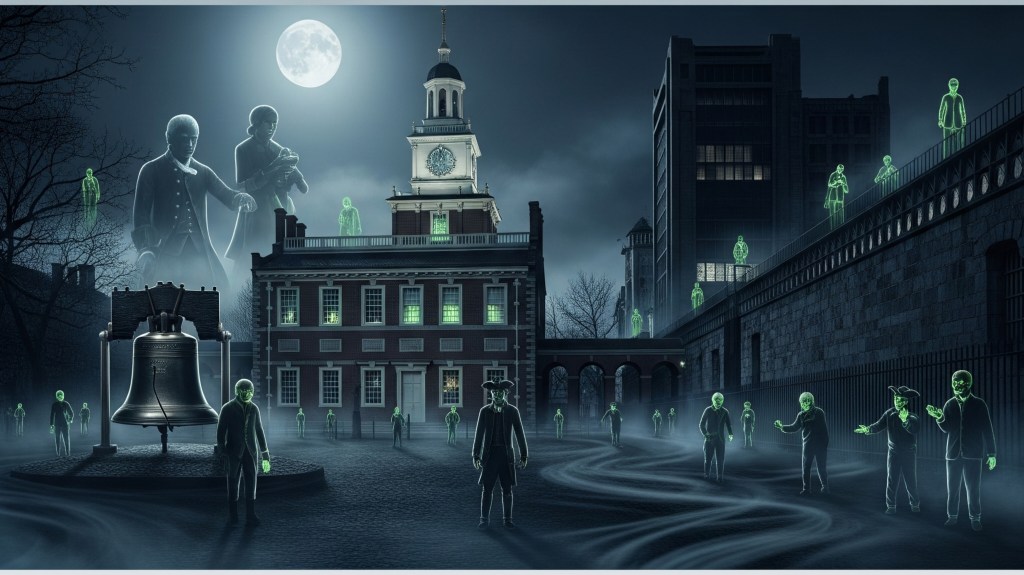
Southeastern Pennsylvania’s paranormal history is a profound and multi-layered narrative that extends far beyond the popular ghost tours of today. A comprehensive analysis reveals that the region’s supernatural landscape is a palimpsest, a historical canvas where the deep-seated spiritual beliefs of the indigenous Lenape people have been overlaid with the psychic residue of subsequent colonial conflict, modern folklore, and unexplained aerial phenomena. This report delves into these layers, establishing that the land itself was viewed as a living, sacred entity long before European arrival. It then explores how the traumas of the Revolutionary and Civil Wars imprinted themselves on key landmarks, creating a rich tapestry of hauntings that persist to this day. Finally, the report examines the contemporary phenomenon of paranormal tourism, arguing that the commercialization of these legends has become a vital, symbiotic force for the preservation of historic sites, transforming ghosts from figures of fear into cultural and economic guardians of the past. The history of the unexplained in this region is not a collection of isolated tales, but a continuous and evolving story that reflects the complex and enduring relationship between human experience, memory, and the land.
Part I: The Deep Roots of the Unexplained: The Indigenous Spiritual Landscape
A complete understanding of southeastern Pennsylvania’s paranormal history must begin not with colonial settlement, but with the ancient spiritual traditions of the region’s first inhabitants. The Lenape, or “Original People,” held a profound and enduring connection to their ancestral homeland, a vast territory they called “Lenapehoking” that encompassed modern-day Pennsylvania, New Jersey, New York, and Delaware.1 For the Lenape, the land was not merely a physical resource; it was a living, sacred entity central to their cultural and spiritual identity. The Delaware River, known to them as “Lenapewihittuck,” was especially revered as a source of spiritual strength and guidance, viewed as a wise elder that communicated lessons through its seasonal transformations.3 This cosmological perspective stands in stark contrast to the later European view of land as a commodity to be acquired and developed. The Lenape creation myth, which describes how the earth was formed on the back of a giant turtle from a piece of old earth retrieved from the depths of a great flood, further underscores this reverence for the land itself as a foundational spiritual space.5
Prior to the arrival of European colonists and their accompanying specters, the supernatural landscape of this region was populated by powerful figures and spirits from Lenape oral tradition. The Lenape believed in Kishelamàkânk, the Creator god who dreamt the world into being, and the manitowak, or life-spirits, which inhabited all living things and were venerated through ceremonies, rituals, and vision quests.5 This spiritual world was not only benevolent but also populated by a range of mythological creatures and beings. Among these were the benevolent culture hero Moskim (Rabbit) and the mischievous but generally harmless Wemategunis, magical “little people of the forest” akin to sprites.6 On the more malevolent side were figures like Mahtantu, the
manëtu (spirit) of death, and fearsome monsters such as the Mhuwe, a man-eating giant.6 The Thunder Beings, often depicted as giant birds, were powerful storm spirits that could be both dangerous and protective, as they were the sworn enemies of the human-eating Underwater Horned Serpents.6
A particularly nuanced figure is the Mesingw, the sacred Mask Spirit that appears to Lenape men in dreams.6 It is important to note that while some modern-day accounts, especially by non-Natives, have associated the Mesingw with Bigfoot, this is not a traditional Lenape belief. This distinction highlights the critical need to separate ancient, culturally specific folklore from contemporary cross-cultural interpretations of paranormal phenomena.6 The historical dispossession of the Lenape from their sacred lands, driven by deceitful transactions like the 1737 “Walking Purchase,” adds a profound layer of trauma to the region’s history.1 This history of displacement means that the paranormal accounts that follow are not isolated events but are built upon a foundation of deep spiritual memory and a history of profound cultural loss. The presence of a Lenape
manëtu and a Revolutionary War ghost in the same area is not a coincidence; it is the superimposition of one cultural narrative onto another, creating a landscape that is rich in layered, psychic resonance.
Part II: Echoes of Conflict: Hauntings of the Revolutionary and Civil War Eras
As colonial history took root, the violent and traumatic events of America’s early conflicts imprinted themselves on the landscape, giving rise to many of the region’s most famous ghost stories. Philadelphia, in particular, served as a nexus of Revolutionary-era history and subsequent paranormal activity. The spirits of the Founding Fathers are said to linger in the city’s most historic sites, with the ghost of Benjamin Franklin reportedly roaming Independence Hall and Christ Church Burial Ground, perhaps keeping watch over the nation he helped create.7 The ghost of Benedict Arnold is said to haunt Independence Hall, burdened by guilt, while Betsy Ross is believed to mourn her personal losses at the house where the first American flag was sewn.7 The Powel House, once a social hub for the colonial elite, is reportedly the site of an unending party attended by the ghosts of Peggy Shippen and shadowy Continental soldiers.11 The Brandywine Battlefield, site of the final engagement in the bloody Battle of Brandywine, is also said to be haunted by fallen soldiers buried in its mass graves.15 A specific legend recounts the ghost of General “Mad Anthony” Wayne, whose spirit is said to ride across the state on his birthday in search of his missing bones, a legend born from the grisly tale of his disinterment.15
One of the most intense concentrations of paranormal phenomena is found at Eastern State Penitentiary, a site whose very architecture was designed to inflict psychological torment. Built in 1829, the prison’s “Pennsylvania System” of solitary confinement was intended to inspire penance by keeping inmates in isolation for up to 23 hours a day, an approach that Charles Dickens described as “immeasurably worse than any torture of the body”.16 Punishments for breaking the silence, such as the “iron gag,” were physically and psychologically brutal.18 The misery and insanity inflicted by this system are said to be still palpable within the prison walls.18 The prison is a well-documented hotspot, with reports of intense negative feelings, shadowy figures, and disembodied voices.18 One of the most famous tales involves infamous mob boss Al Capone, who during his 8-month stint, was reportedly haunted by the ghost of James Clark, a victim of the St. Valentine’s Day Massacre.18 Other chilling accounts include a maintenance worker who was reportedly restrained by an invisible force while seeing the faces of tormented souls appear on the cell walls.18
Fort Mifflin is another critical site of layered trauma from multiple conflicts, serving as a Revolutionary War fortress and later a Civil War prison.21 The fort’s history of suffering, where thousands of Civil War soldiers perished from disease and starvation, has made it a renowned hub of paranormal activity.22 Among its most well-known spirits is the “Screaming Woman,” believed to be Elizabeth Pratt, a sergeant’s wife whose agony over losing her two children to yellow fever is still heard in her blood-curdling screams.21 Another prominent figure is the “Faceless Man,” an apparition in Civil War attire who is seen roaming the fort.21 While folklore paints him as a vengeful outlaw, historical records present a more tragic figure: William H. Howe, the only Union soldier executed at the fort.21 Howe, a brave soldier, reportedly shot an arresting officer while suffering from dysentery and was sentenced to public hanging as a deterrent for desertion.22 The detail that a bag was placed over his head is offered as the reason for his faceless apparition.22 The fort is also home to other spirits, including the “Lamplighter” (Joseph Adkins) and the blacksmith “Jacob,” whose hammer can be heard clanging from the former blacksmith shop.21
The concentration of these ghost stories in areas of historical trauma illustrates a pattern. The psychic and emotional turmoil of battlefields, prisons, and places of suffering appears to create a residual energy that manifests as paranormal phenomena. This observation suggests that these specific locations function as historical anchors, retaining and replaying the emotional intensity of the past for contemporary witnesses.
Part III: Cryptids, Anomalies, and Unidentified Phenomena
Expanding beyond the traditional ghost story, southeastern Pennsylvania’s paranormal history also includes a rich vein of cryptid folklore and a surprising number of unidentified aerial phenomena. One of the most complex regional legends is the “Ape Boy of the Chester Swamps.” The legend tells of a “red-headed kid” who was “hated” for his appearance and ran into the swamps over 250 years ago, transforming into a wild, ape-like figure.27 The legend has evolved, with the creature now believed to roam the John Heinz National Wildlife Refuge at Tinicum, a remnant of the drained swamps.28 An older, historical account, however, provides a more troubling context, revealing that a similar creature was once identified as a “half-witted wandering negro”.30 This racial subtext points to the problematic origins of certain folklore, where marginalized individuals were demonized and relegated to the status of a monstrous cryptid.
The region is also home to a variety of other creatures from local lore. In northern Pennsylvania, the weeping Squonk is a mythical creature that reportedly dissolves into a puddle of tears when cornered, due to its unhappiness with its wart-covered skin.27 In Montgomery County, the Bryn Athyn Beast is described as a “Dogman-type creature” that stands six to seven feet tall and can reportedly walk on both two and four legs.27 Other statewide cryptids include the Potter Nondescript, a hairy, six-foot-tall creature with tusks 27, and the Giwoggle, a wolf-bird-horse hybrid.36 Pennsylvania has also been a hotspot for sightings of the Jersey Devil, particularly during a “flap” of dozens of sightings in 1909 where it was reportedly seen just over the border from New Jersey.27
In addition to creature lore, southeastern Pennsylvania has a history of unidentified aerial phenomena. These reports date back to the 19th century, including a widely reported 1869 sighting in Lancaster County of a luminous, “silver column” that settled in a field before disappearing.39 A more recent, but still historical, case occurred in Chester in 1952, when a young boy and his family reportedly saw four oval-shaped objects moving in a formation.40 The region is also proximal to the highly-publicized Kecksburg Incident of 1965 in western Pennsylvania, where a fireball reportedly crashed, leading to claims of a secret military operation and the recovery of an acorn-shaped object.41 More recently, paranormal investigator Eric Mintel has documented hundreds of sightings of unexplained lights and “drones” in Bucks County and New Jersey in 2024. Witnesses described objects with no sound or transponders that displayed “precise, intelligent movement patterns”.41
The stories of cryptids and UFOs in this region are not isolated categories of the unexplained. There is a documented correlation between these phenomena, with sightings of Bigfoot-like creatures often occurring in the same areas and times as “mystery lights” and UFOs.30 The work of local investigators like Eric Mintel, who documents both UFO and “Dogman” reports, further illustrates this interconnectedness.41 For many enthusiasts and witnesses, the unexplained is a singular, multi-faceted phenomenon rather than a series of distinct, unrelated categories. This overlapping of phenomena speaks to a shared human desire to seek out and explain the mysterious, whether that mystery is terrestrial, extraterrestrial, or something in between.
Part IV: The Modern Paranormal Ecosystem: Commerce, Preservation, and Culture
The history of the unexplained in southeastern Pennsylvania has transcended folklore and become a vibrant economic driver and a powerful tool for cultural and historic preservation. This phenomenon, often referred to as the “ghost economy,” is a booming niche market with significant economic implications.41 The global “dark tourism” market is valued at over $30 billion, and a large portion of this is fueled by ghost-related travel.45 Local ghost tours and haunted attractions have a positive impact on communities, as they attract visitors who patronize hotels, restaurants, and other businesses.44
The region’s thriving paranormal tourism industry includes popular attractions like the “original Ghost Tour of Philadelphia,” which offers candlelight walking tours of historic sites such as Independence Hall and Washington Square.47 The tours are rooted in documented ghostlore and are based on the book
Ghost Stories of Philadelphia, PA.47 Beyond the walking tours, the region offers a variety of commercial “haunted” experiences, including haunted houses and hayrides at places like Pennhurst Asylum, the Bates Motel, and Sleepy Hollow Haunted Acres.49 Historic inns throughout Bucks County have also embraced their supernatural reputations, with places like the Aaron Burr House Bed and Breakfast and the Black Bass Hotel advertising their haunted histories to attract guests.13
The commercialization of paranormal history has become a critical lifeline for aging landmarks. A 2020 study in the Cornell Hospitality Quarterly found that haunted tourism provides the necessary funding for historic sites to “remain intact” and “make necessary improvements”.45 The revenue from ghost tours, paranormal investigations, and haunted attractions directly funds the preservation and upkeep of buildings that might otherwise fall into disrepair. A prime example is Eastern State Penitentiary, where the annual “Halloween Nights” event generates profits used for year-round maintenance of the historic prison.49 Similarly, Fort Mifflin, a national historic landmark, offers public and private “Sleep with the Ghosts” events and investigations that generate revenue for the non-profit organization that stewards the property.22 This commercial model, while seemingly antithetical to the seriousness of history, has created a symbiotic relationship where the ghost is no longer just a figure of fear but a financial guardian of history.
The modern paranormal ecosystem is heavily influenced by books, television shows, and social media, which have amplified local legends and turned them into national attractions. The work of local authors like Charles J. Adams III, who has written dozens of books on Pennsylvania ghosts, has helped to codify and disseminate these stories to a wider audience.18 Popular media, from television shows like
Unsolved Mysteries and Ghost Hunters to online videos, has brought these local haunts to a national stage.10 This media exposure fuels public fascination and drives the influx of visitors and revenue, creating a virtuous cycle where commercial success ensures the survival of the historical narratives and the physical sites that house them. In this context, the pursuit of the paranormal is a modern-day quest to connect with and preserve the past, ensuring that the stories of those who came before us are not forgotten.
Table 1: Notable Haunted Locations of Southeastern Pennsylvania
| Location Name | Primary Historical Period | Type of Site | Summary of Historical Context | Associated Spirits/Phenomena |
| Fort Mifflin | Revolutionary & Civil War | Fort/Prison | Site of a Revolutionary War siege and later a Civil War prison where thousands died from disease and starvation. | The Screaming Woman (Elizabeth Pratt), The Faceless Man (William H. Howe), disembodied voices, shadowy figures, and phantom soldiers. |
| Eastern State Penitentiary | 19th-20th Century | Prison | An architectural marvel designed to inflict penance through extreme solitary confinement and psychological torture. | Al Capone’s ghost (James Clark), a tormented maintenance worker, shadow figures, and disembodied voices and cackling laughter. |
| Powel House | Colonial/Revolutionary | Mansion | A hub for colonial-era socializing where America’s Founding Fathers attended parties. | The ghost of Peggy Shippen and shadowy apparitions of Continental Army soldiers. |
| Brandywine Battlefield | Revolutionary War | Battlefield | Site of a bloody battle with mass graves for fallen soldiers. | A wounded soldier, phantom horses, a crying child, and the ghost of General “Mad Anthony” Wayne. |
Table 2: Regional Cryptids and Mythological Beings
| Creature Name | Associated Location(s) | Description & Behavior | Historical/Mythological Origin |
| Ape Boy | Chester Swamps/John Heinz National Wildlife Refuge | A large, ape-like figure covered in red hair that stalks the swamps. | A legend originating over 250 years ago from the story of a “red-headed kid” who was “hated” and ran into the swamps. Later historical accounts associate similar creatures with a problematic racial subtext. |
| Bryn Athyn Beast | Bryn Athyn, Montgomery County | A dog-like creature, 6-7 feet tall, that can walk on two and four legs. It glides silently and will defend itself. | First sighted in the 1990s, the creature is part of the broader “Dogman” folklore. |
| Squonk | Hemlock forests of Northern PA | A pig-like creature with sagging, wart-covered skin that weeps constantly and can dissolve into a puddle of tears. | A mythical creature from American folklore first described in the 1910 book Fearsome Creatures of the Lumberwoods. |
| Jersey Devil | Pine Barrens, New Jersey (sighted in PA) | A creature with a horse’s head, bat’s wings, and glowing red eyes that walks on two long and two short legs. | An authentic folk legend with sightings dating back over 250 years, with a notable “flap” of sightings in southeastern Pennsylvania in 1909. |
Conclusion
The paranormal history of southeastern Pennsylvania is a rich and complex narrative woven from multiple threads of human experience. From the foundational spiritual reverence of the Lenape people for their lands and rivers to the residual trauma of colonial-era and Civil War conflicts, the region’s history of the unexplained is deeply rooted in its past. The modern commercialization of this history through a booming paranormal tourism industry represents a powerful and unexpected new chapter. The ghost is no longer merely a terrifying specter but a character in a commercial ecosystem, a powerful engine that drives revenue and public interest, which in turn ensures the survival of historic sites and their stories. The investigation into these phenomena is a constant reminder that the past is not a static, forgotten entity but a living, breathing force that continues to shape the present. The search for the unexplained in southeastern Pennsylvania is, at its heart, a profound and meaningful endeavor to understand and preserve the complex legacy of those who walked the land before us.


 Paranormal POV
Leave a comment