
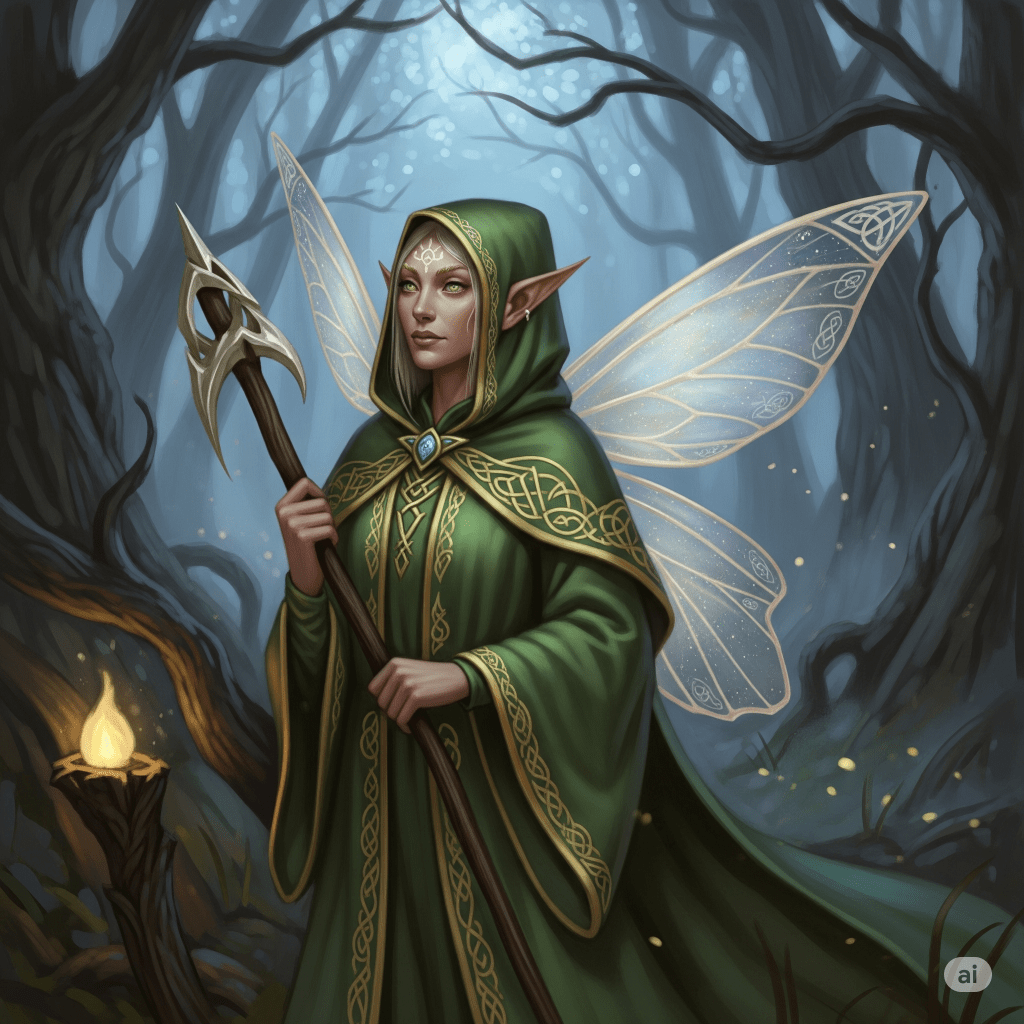
When one thinks of British folklore, ghosts often come to mind, but another ancient and equally pervasive presence is that of the Fae. Far from the diminutive, winged figures of modern popular culture, the fairies of British lore are complex, often ambivalent beings whose stories are deeply woven into the fabric of the land, particularly in Ireland and Scotland.
Beyond “Tinkerbell”: The True Nature of the Fae
The term “fairy” itself, along with “fae” or “faerie,” is often considered an unsuitable or even disrespectful term in the context of traditional Irish and Scottish lore, as it falsely equates them with the harmless, minuscule creatures of English popular culture.1 Instead, they are known by many names and circumlocutions, such as
Aes sídhe or daoine sídhe (people of the mounds), na daoine maithe (the good people), na daoine úaisle (the noble people), or simply “the other crowd”.2 These names reflect a cautious respect, as directly naming them could invoke them.1
In traditional belief, the Fae are often described as looking just like humans, though they possess the ability to conceal themselves by existing on another plane.1 They live lives much like our own, but their true nature is far from harmless; they are capable of destroying people’s lives.2
Ancient Origins and Shifting Perceptions
The origins of the Fae are deeply rooted in ancient Celtic mythology. In Irish tradition, the Tuatha Dé Danann (people of the Goddess Danu), a supernatural race of people, retreated to the hills, cairns, and burial mounds (tumuli) dotting the countryside after battling with the Gaels.2 Later tradition explicitly connects these places as the abodes of the fairies, suggesting that the Fae may have originally been associated with the ancestor dead before evolving into an “otherworld community”.2
As Christianity spread across Britain, the perception of these ancient beings began to shift. The Early Church recognized their mythical and spiritual nature, leading to their demonization.2 Continental theologians developed a rationale that fairies were, in fact, fallen angels—a concept that spread to Ireland and was adopted into fairy lore towards the end of the Middle Ages.2 This interpretation suggested that God allowed these angels to remain where they fell, with those who landed on Earth becoming the fairies, and those still falling living in the air.2
Ambivalent Powers and Diverse Manifestations
British Fae are often depicted with an ambivalent nature, capable of both alluring charm and dangerous malice. They were historically held responsible for inflicting sudden and mysterious illnesses, rashes, and pains in humans and animals.3 Yet, they could also be beautiful and alluring, appearing dancing at night in wild places, sometimes even mating with humans.3
Different types of Fae exist across the British Isles. In early and high medieval Britain, the term “fairy” had not yet been imported, but roughly equivalent beings called “elves” were present, later becoming elided with the category of fairy.3 These Anglo-Saxon elves were often associated with beauty and allure.3 Some Fae, like brownies, hobs, and familiars, were believed to live in human homes or serve individuals, sometimes acting as guides.4
A significant division in Gaelic and Scottish folklore is between the “Seelie” and “Unseelie” Courts, representing two differing “houses” of Fae with distinct motivations, neither wholly good nor wholly bad.4 Even the Banshee, the wailing female spirit whose scream warns of impending death, is considered a type of fairy.4
Historically, belief in the Fae was widespread, especially in rural areas of Ireland and Scotland, where the vastness of dark nights and grim summers made the unseen world feel very close.4 People would protect their homes with charms, cold iron, and even the Bible to ward off the Fae.4
The rich and varied lore of the Fae reflects a deep cultural connection to the natural world and a complex understanding of the unseen forces that shape human experience. These ancient beings continue to captivate, reminding us of the thin veil between our world and theirs.
Footnotes
1 IrishFolklore. “Fairies and Fairy lore: The reality of the Irish fairy.”
IrishFolklore.wordpress.com, December 22, 2018. https://irishfolklore.wordpress.com/2018/12/22/fairies-and-fairy-lore-the-reality-of-the-irish-fairy/
2 Ask About Ireland. “Supernatural Legend.”
Ask About Ireland, n.d. https://askaboutireland.ie/reading-room/history-heritage/folklore-of-ireland/folklore-in-ireland/legend-and-belief/supernatural-legend/
3 Laphams Quarterly. “The Prehistory of the Fairy Realm.”
LaphamsQuarterly.org, n.d. https://www.laphamsquarterly.org/roundtable/prehistory-fairy-realm
4 Fantasy-Faction. “Faeries and Folklore Part One: An Introduction.”
Fantasy-Faction.com, November 1, 2016. https://fantasy-faction.com/2016/faeries-and-folklore-part-one-an-introduction
5 The Irish Jewelry Company. “Ireland’s Best Known Spirit: The Banshee.”
TheIrishJewelryCompany.com, n.d. https://www.theirishjewelrycompany.com/blogs/irish-interest/irelands-best-known-spirit-the-banshee
6 The Irish Road Trip. “Irish Mythological Creatures and Monsters from Celtic Folklore.”
TheIrishRoadTrip.com, n.d. https://www.theirishroadtrip.com/irish-mythological-creatures/


 Paranormal POV
Leave a comment