
Edgar Allan Poe’s “The City in the Sea” was first published in 1831. It appeared in the collection titled “Poems by Edgar A. Poe” published in London. This early publication played a crucial role in introducing Poe’s poetic talent to a wider audience.
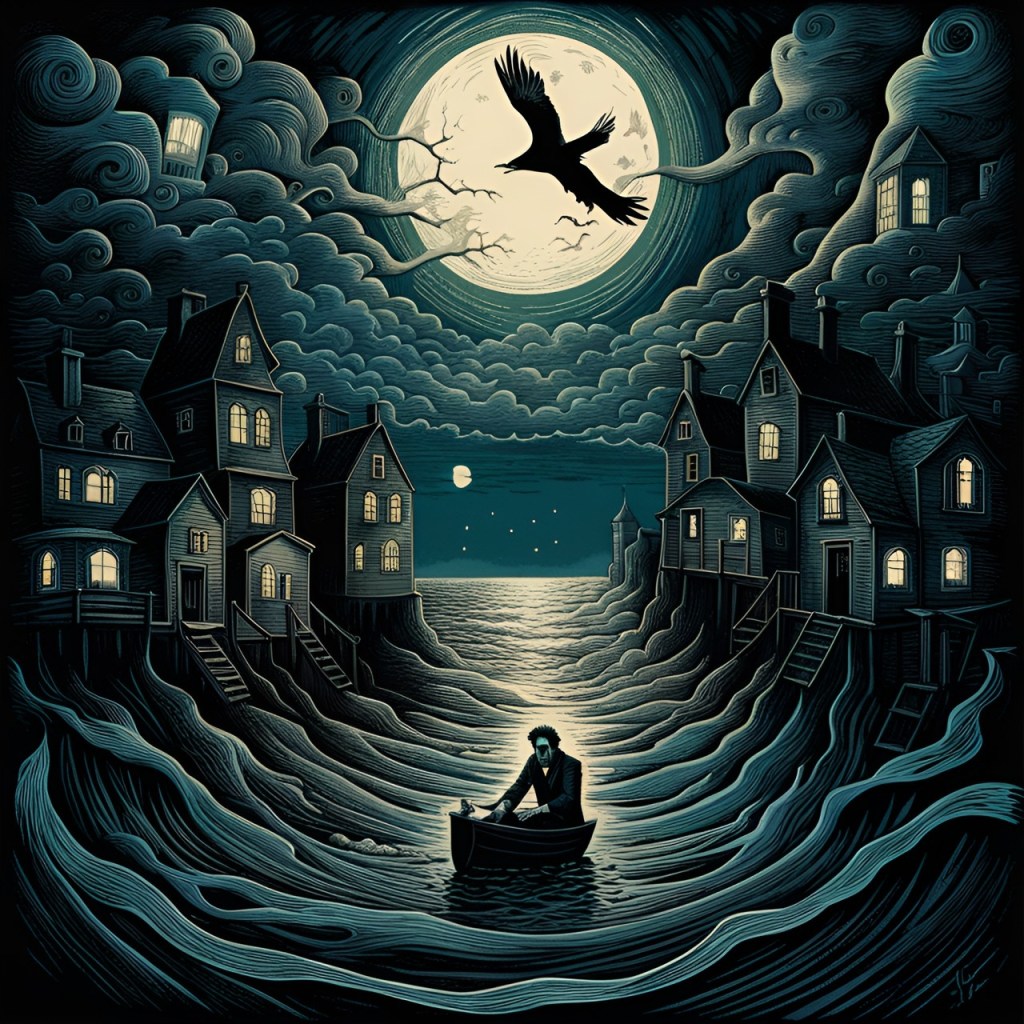
Edgar Allen Poe’s Poem, “The City in the Sea”
Lo! Death has reared himself a throne
In a strange city lying alone
Far down within the dim West,
Where the good and the bad and the worst and the best
Have gone to their eternal rest.
There shrines and palaces and towers
(Time-eaten towers and tremble not!)
Resemble nothing that is ours.
Around, by lifting winds forgot,
Resignedly beneath the sky
The melancholy waters lie.
No rays from the holy Heaven come down
On the long night-time of that town;
But light from out the lurid sea
Streams up the turrets silently—
Gleams up the pinnacles far and free—
Up domes—up spires—up kingly halls—
Up fanes—up Babylon-like walls—
Up shadowy long-forgotten bowers
Of sculptured ivy and stone flowers—
Up many and many a marvellous shrine
Whose wreathed friezes intertwine
The viol, the violet, and the vine.
Resignedly beneath the sky
The melancholy waters lie.
So blend the turrets and shadows there
That all seem pendulous in air,
While from a proud tower in the town
Death looks gigantically down.
There open fanes and gaping graves
Yawn level with the luminous waves;
But not the riches there that lie
In each idol’s diamond eye—
Not the gaily-jewelled dead
Tempt the waters from their bed;
For no ripples curl, alas!
Along that wilderness of glass—
No swellings tell that winds may be
Upon some far-off happier sea—
No heavings hint that winds have been
On seas less hideously serene.
But lo, a stir is in the air!
The wave—there is a movement there!
As if the towers had thrust aside,
In slightly sinking, the dull tide—
As if their tops had feebly given
A void within the filmy Heaven.
The waves have now a redder glow—
The hours are breathing faint and low—
And when, amid no earthly moans,
Down, down that town shall settle hence,
Hell, rising from a thousand thrones,
Shall do it reverence.
Unveiling the Enigmatic Depths of Edgar Allan Poe’s “The City in the Sea”
Edgar Allan Poe, a literary maestro renowned for his dark and mysterious tales, weaves a mesmerizing tapestry of the macabre in his poem “The City in the Sea.” Published in 1831, this enigmatic piece delves into the depths of human nature, exploring themes of decay, mortality, and the relentless passage of time.
A Haunting Atmosphere
“The City in the Sea” begins by painting a vivid and haunting picture of a city that lies in a desolate and remote location, surrounded by the vastness of the sea. Poe’s use of vivid imagery and atmospheric language immediately transports the reader into a realm shrouded in an eerie and foreboding ambiance.
Allegorical Layers
As with many of Poe’s works, “The City in the Sea” possesses allegorical layers that invite readers to delve deeper into its meaning. The city itself can be interpreted as a metaphor for the inevitability of death, with its looming towers symbolizing the inescapable reach of mortality. The sea, in turn, becomes a representation of time’s inexorable march, engulfing everything in its path.
The Personification of Decay
Poe introduces the haunting figure of Death, personified as a king ruling over the city with an iron hand. The decay and desolation that permeate the city reflect the universal truth of life’s transience. The poet skillfully weaves a tale where even grandeur succumbs to the relentless forces of decay.
Melancholic Beauty
Despite the grim themes, Poe infuses “The City in the Sea” with a melancholic beauty. The poem’s rhythmic cadence and carefully chosen words create a lyrical quality that captivates readers, drawing them into the haunting landscape. The interplay of light and shadow in Poe’s language adds depth to the narrative, making it an evocative exploration of the human condition.
Artistic Legacy
“The City in the Sea” stands as a testament to Poe’s enduring impact on literature and the gothic genre. Its influence reverberates through the works of subsequent writers and artists, inspiring a myriad of interpretations and adaptations. From literature to visual arts, the poem continues to be a wellspring of inspiration for those drawn to the mysterious and the macabre.
Conclusion
Edgar Allan Poe’s “The City in the Sea” remains a timeless piece that beckons readers to confront the inevitability of mortality and the haunting beauty that often accompanies decay. Through its vivid imagery, allegorical depth, and poetic grace, the poem continues to resonate with audiences, inviting them to explore the shadows that linger within the recesses of the human soul.


 Paranormal POV
Leave a comment